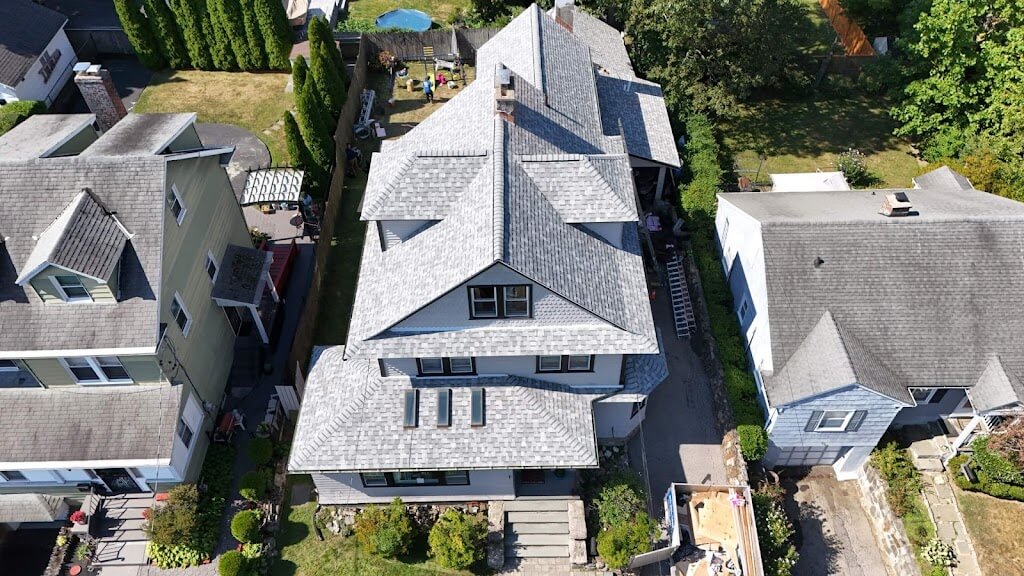
Armonk roofs deal with a different set of pressures than most of Westchester County — pressures that come from geography and architecture rather than density. Sitting in the hilly, heavily wooded terrain of the Town of North Castle near the Connecticut border, Armonk properties are shaded for much of the year by mature tree canopy, sit at elevations that swing 300–500 feet across the town, and are frequently built with the large, multi-plane rooflines that define the area’s custom colonials, contemporary estates, and horse-country properties. That combination — deep shade delaying snowmelt, elevation-driven frost pockets in low-lying areas near Byram Lake and the surrounding reservoirs, and roof geometries with a dozen or more planes, valleys, and skylights — creates a roofing environment where generic suburban repair approaches routinely miss what’s actually happening on the roof. On Time Roofing of Armonk has spent more than ten years working specifically in this environment, developing expertise in premium materials like cedar shake and standing seam metal, complex custom rooflines, and the permitting and architectural review processes that govern North Castle’s residential and corporate properties.
We know the difference between a cedar shake roof shaded under old-growth oak on Whippoorwill Road and an open-exposure asphalt roof on a hilltop lot near Bedford Road. We know how tree debris and moss accumulation behave differently on a heavily wooded three-acre lot than on a cleared contemporary build, and why the flashing package that works on a simple gable roof is inadequate for the eight-valley custom estate homes common throughout North Castle. Serving Armonk, Bedford, Chappaqua, Mount Kisco, and the broader northern Westchester and lower Fairfield County market, we bring the local material and terrain knowledge that national chains and out-of-region contractors can’t replicate.
Armonk isn’t a dense suburban market, and its roofing needs reflect that. The combination of its wooded, hillside terrain, its concentration of large custom-built homes, and the permitting and architectural review environment governing North Castle creates roofing demands that a contractor without direct local experience will consistently underestimate.
Armonk’s climate is shaped less by urban heat than by elevation, tree cover, and its inland position near the Connecticut border — roughly ten miles further from the coastal moderating effect than communities along the Hudson. The town’s terrain varies by 300–500 feet in elevation across a few miles, creating localized frost pockets in low-lying areas near Byram Lake, Cox Avenue, and the Kensico watershed that can run several degrees colder overnight than higher ground a short distance away. Armonk receives an average of 48–50 inches of annual precipitation, including 30+ inches of snowfall — slightly higher than communities closer to the river — but the defining factor for roofing is tree canopy. Heavily wooded lots throughout Whippoorwill, Middle Patent, and the Bedford Road corridor keep large sections of roof in shade for most of the winter day, meaning snow and ice on north-facing slopes and tree-shaded valleys can persist for days after open-exposure roofs nearby have fully cleared. That prolonged snow and ice retention is what drives ice dam formation in Armonk — not urban heat loss from old attic construction, but shade-driven melt-refreeze cycling concentrated on specific roof planes.
Armonk’s residential inventory is shaped by its history as a low-density, large-lot community that has grown around IBM’s corporate presence and North Castle’s horse-country character. The town’s housing stock ranges from 18th- and 19th-century farmhouses along Bedford Road and Route 22 to the custom colonial, contemporary, and shingle-style estate homes built from the 1960s through today in developments like Whippoorwill, Windmill Club, and the properties surrounding Byram Hills. These homes are typically larger than the Westchester County average — commonly 3,500 to 10,000+ square feet — and are built with correspondingly complex rooflines: multiple gables, dormers, skylights, and valley intersections that can number a dozen or more distinct roof planes on a single property. Cedar shake and cedar shingle roofing is common on Armonk’s estate-style homes, alongside slate on some of the area’s older farmhouses and a growing number of standing seam metal installations on newer construction. Along the Route 22 and King Street corridors, North Castle’s commercial and corporate inventory — including office parks near the IBM campus, medical buildings, and retail centers — adds a separate category of flat and low-slope roofing entirely distinct from the residential market.
Roofing work in Armonk operates within a layered approval environment shaped by the town’s zoning structure and its private-community governance. The Town of North Castle requires building permits for roof replacements and most structural repair work, administered through the North Castle Building Department. Processing times typically run 2–4 weeks for standard residential work — longer for properties within town-designated scenic or conservation overlay districts, where the Planning Board may weigh in on exterior material changes visible from the road. A meaningful share of Armonk’s premium housing sits within private communities — Whippoorwill Club, Windmill Club, and several gated developments — where homeowners association architectural committees separately review roofing material, color, and profile before work can proceed, in addition to town permitting. Insurance claims for storm damage or tree-fall damage involve New York State insurance regulations, and documentation requirements for high-value Westchester County homeowners’ policies warrant contractor experience with New York-specific claims handling on larger, more complex properties.
After ten-plus years of roofing work across Armonk and the broader North Castle market, On Time Roofing has developed a clear picture of the failure patterns that appear most consistently on properties in this town. Every problem below is driven by the specific combination of terrain, tree cover, and custom construction that defines the Armonk market.
Ice dams form when snow on a warmer section of roof melts, flows toward a colder edge or valley, and refreezes into a ridge that forces subsequent meltwater up under shingles or shakes and into the building interior. In Armonk, the primary driver isn’t attic heat loss — it’s tree canopy. Heavily wooded lots throughout Whippoorwill, Middle Patent, and the properties bordering Byram Lake keep entire roof sections in shade through the shortest days of winter, so snow and ice on those planes persists and cycles through freeze-thaw long after open, sun-exposed roof sections have cleared. Complex custom rooflines compound the problem: valleys where two or more roof planes meet concentrate snow depth and are frequently among the last areas to fully melt.
Signs you’ll notice:
Armonk-specific patterns: Estate homes on heavily wooded lots in Whippoorwill and along Middle Patent Road show the most persistent ice dam activity, concentrated on north- and east-facing valleys. Custom homes with skylights near roof valleys are particularly vulnerable, since the valley and the skylight flashing junction both concentrate water in the same location.
Severity: Serious. Active ice dams can introduce several gallons of water per day into ceiling and wall assemblies below the affected valley. Address current-season ice dams and schedule a valley-flashing and ventilation assessment for the following season.
Typical solution: Emergency ice dam removal using steam, targeted ice-and-water shield reinforcement at affected valleys and eaves, and, where tree cover is a contributing factor, evaluation of selective limb clearance in coordination with an insured tree service.
Cedar shake and cedar shingle roofing is one of the defining materials on Armonk’s estate-style homes, prized for its appearance and performance on large custom rooflines — but it requires a level of maintenance and moisture management that shaded, wooded lots make more demanding than open-exposure properties elsewhere in Westchester. Cedar deteriorates through a combination of UV exposure, moisture retention, and biological growth; on shaded lots, moisture retention and moss or algae growth accelerate that process well ahead of the material’s rated service life.
Signs you’ll notice:
Armonk-specific patterns: Estate homes under mature tree canopy in Whippoorwill and the Byram Lake area show the fastest cedar deterioration, particularly on north-facing slopes that receive minimal direct sun. Homes where gutters and valleys haven’t been cleared of leaf litter on a regular schedule show accelerated rot at those specific locations well before the field of the roof shows comparable wear.
Severity: Moderate to Serious. Isolated shake replacement can extend service life significantly; systemic moss penetration and underlying deck moisture typically indicate the system has reached the point where full replacement outperforms continued spot repair.
Typical solution: Selective shake replacement and moss treatment where the system is fundamentally sound, or full cedar re-roof with modern breathable underlayment where deterioration is systemic — with an option to transition to a lower-maintenance material such as standing seam metal or a cedar-profile architectural shingle where the homeowner prefers reduced upkeep.
Armonk’s custom-built homes routinely include eight, ten, or more distinct roof planes, meeting at valleys, dormers, chimneys, and skylight curbs — and every one of those transitions is a flashing junction that can fail independently of the surrounding roof field. On a simple gable roof there may be only a handful of these junctions; on a large Whippoorwill or Windmill Club estate, there can be dozens, each requiring correct step flashing, counter-flashing, or curb flashing appropriate to the specific material and geometry involved.
Signs you’ll notice:
Armonk-specific patterns: Custom estate homes with multiple dormers and skylights in Windmill Club and along Whippoorwill Road show the highest concentration of flashing-related leak calls, simply due to the sheer number of transition points on these rooflines. Properties with additions built at different times — common on older Bedford Road farmhouses that have been expanded — frequently show flashing failures at the seam where old and new roof sections meet.
Severity: Serious. Flashing failures allow water infiltration with every rain event, and on complex rooflines the leak’s interior appearance often doesn’t line up directly below the actual failure point, delaying diagnosis. Long-unaddressed flashing leaks frequently produce structural damage to rafters and decking near the affected junction.
Typical solution: Systematic flashing assessment across every valley, dormer, chimney, and penetration point, followed by complete flashing replacement at failed junctions using materials matched to the surrounding roof system.
North Castle’s commercial inventory along the Route 22 and King Street corridors — including office parks near the IBM campus, medical office buildings, and retail centers — relies on flat or low-slope membrane roofing distinct from the pitched residential systems that dominate Armonk’s housing stock. Modified bitumen, TPO, and EPDM systems on these properties are subject to standard membrane failure modes — seam separation, ponding, and penetration leaks around rooftop HVAC units — and many of the area’s older commercial buildings carry membrane systems installed in the 1990s and early 2000s that are now approaching or past their expected service life.
Signs you’ll notice:
Armonk-specific patterns: Office and medical buildings along Route 22 with rooftop HVAC units added or upgraded after original construction show accelerated membrane stress at penetration points. Retail and corporate properties near the King Street corridor experience above-average wind exposure at parapet edges due to the area’s open, elevated terrain.
Severity: Serious to Emergency. Active membrane failures in occupied commercial space represent both a property damage and tenant liability concern.
Typical solution: Full membrane assessment, drain clearing and slope correction where standing water is present, targeted repair for isolated failures, or full tear-off and replacement for systems past useful service life.
Armonk’s heavily wooded terrain is a defining asset for the town’s character — and a recurring source of roof damage. Falling limbs and, less frequently, whole trees are one of the most common causes of point-impact roof damage in North Castle, ranging from a single cracked shingle or shake to a full deck puncture requiring emergency tarping. Nor’easters and summer thunderstorms with damaging wind gusts are the most common trigger, but standing dead limbs can fail during comparatively minor weather events simply due to age and decay.
Signs you’ll notice:
Armonk-specific patterns: Heavily wooded properties in Whippoorwill, Middle Patent, and along Byram Lake see the highest volume of tree-fall calls, particularly after Nor’easters and summer microburst events. Homes with mature trees overhanging the roofline — common throughout North Castle’s older, established lots — carry elevated risk regardless of the roof system’s age or condition.
Severity: Emergency. Impact damage that breaches the deck allows large volumes of water entry during subsequent precipitation and should be tarped within hours of discovery.
Typical solution: Emergency tarping and debris clearing, coordinated removal of hazard limbs with an insured tree service where needed, followed by targeted repair or replacement of the affected roof section and structural assessment of any impacted decking or rafters.
Skylights and dormers are common features on Armonk’s custom and contemporary homes, bringing natural light into cathedral ceilings and upper-floor living space — but each skylight curb and dormer cheek wall is an additional flashing system layered into the roof, and one of the more failure-prone details on any custom build. Improperly flashed or aging skylight curbs allow water to track along the roof deck before appearing as an interior stain, often at a distance from the actual entry point.
Signs you’ll notice:
Armonk-specific patterns: Contemporary homes with multiple skylights, common in newer construction throughout North Castle, show the highest incidence of skylight-related leak calls — particularly where skylights are original to a home now 20+ years old and the flashing has aged past its functional life. Dormer-heavy colonial and shingle-style homes in Windmill Club show a similar pattern at cheek wall flashing.
Severity: Moderate to Serious. Skylight leaks are often intermittent and easy to underestimate until decking damage has already occurred.
Typical solution: Skylight curb and flashing replacement using current manufacturer specifications, or full skylight unit replacement where the glazing seal has also failed, combined with dormer cheek wall flashing correction where applicable.
Not every Armonk property sits under heavy tree cover — the town’s newer developments and open hilltop lots, particularly along ridgelines near the Bedford Road and King Street corridors, carry standard asphalt shingle roofing fully exposed to sun and wind. Granule loss — the shedding of the mineral coating that provides UV resistance and weathering durability — progresses faster on these open, elevated properties than on shaded lots, and North Castle’s higher-elevation terrain sees stronger sustained wind exposure during storm events than lower-lying parts of Westchester County.
Signs you’ll notice:
Armonk-specific patterns: Open, elevated properties along ridgelines near Bedford Road and the King Street corridor show the fastest granule depletion and the highest incidence of wind-driven shingle displacement during storm events, due to the combination of direct sun exposure and unobstructed wind at elevation.
Severity: Moderate to Serious. End-of-life granule exhaustion indicates replacement planning is needed within 2–3 years to prevent deck damage from prolonged moisture infiltration.
Typical solution: Full roof replacement with dimensional architectural shingles rated for high wind exposure, ice-and-water shield at eaves and valleys per New York State code, and ridge vent installation where attic ventilation is deficient.
On Time Roofing of Armonk provides the full spectrum of residential and commercial roofing services for a market defined by custom construction and wooded terrain — from cedar shake repair on a Whippoorwill estate to full membrane replacement on a Route 22 office building. Every service is calibrated to the specific materials, terrain conditions, and approval processes that North Castle properties require.
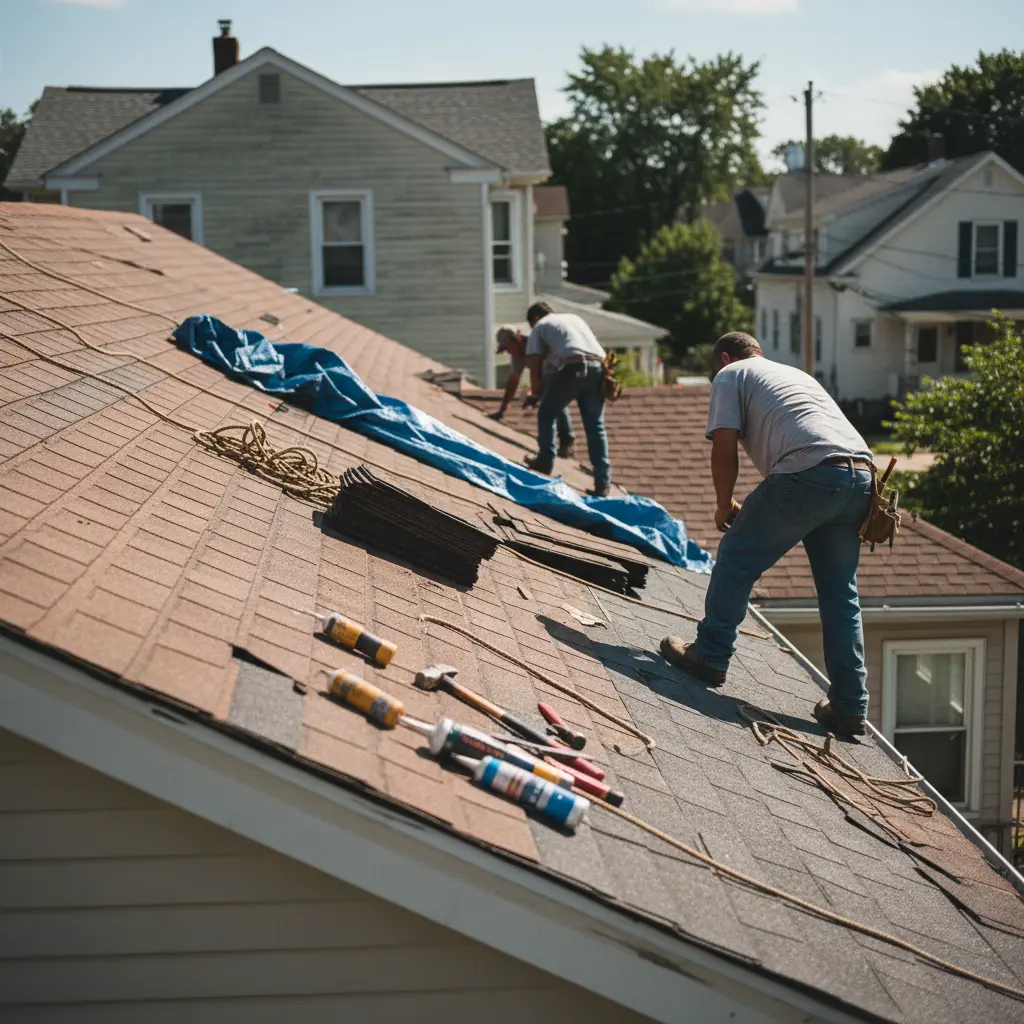
We provide emergency tarping, debris removal, and damage containment for active roof failures — tree-fall impact, storm damage, ice dam breaches, and any situation allowing immediate water entry. Emergency response is available throughout Armonk and the surrounding 20-mile service radius.
Emergency services include rapid-deploy tarping over exposed areas, photograph documentation for insurance purposes, and coordinated removal of hazard limbs or debris where a tree service is needed alongside roof repair. In North Castle’s storm season — including summer thunderstorm events and the Nor’easter season from November through March — emergency demand spikes after significant wind events. We maintain response capacity to reach emergency calls within the same business day where conditions allow.
Full roof replacements from tear-off through finished installation — managing North Castle building permit applications and, where applicable, HOA architectural review submissions, deck inspection and repair, underlayment appropriate for New York State’s climate requirements, and complete new shingle, shake, or standing seam metal installation.
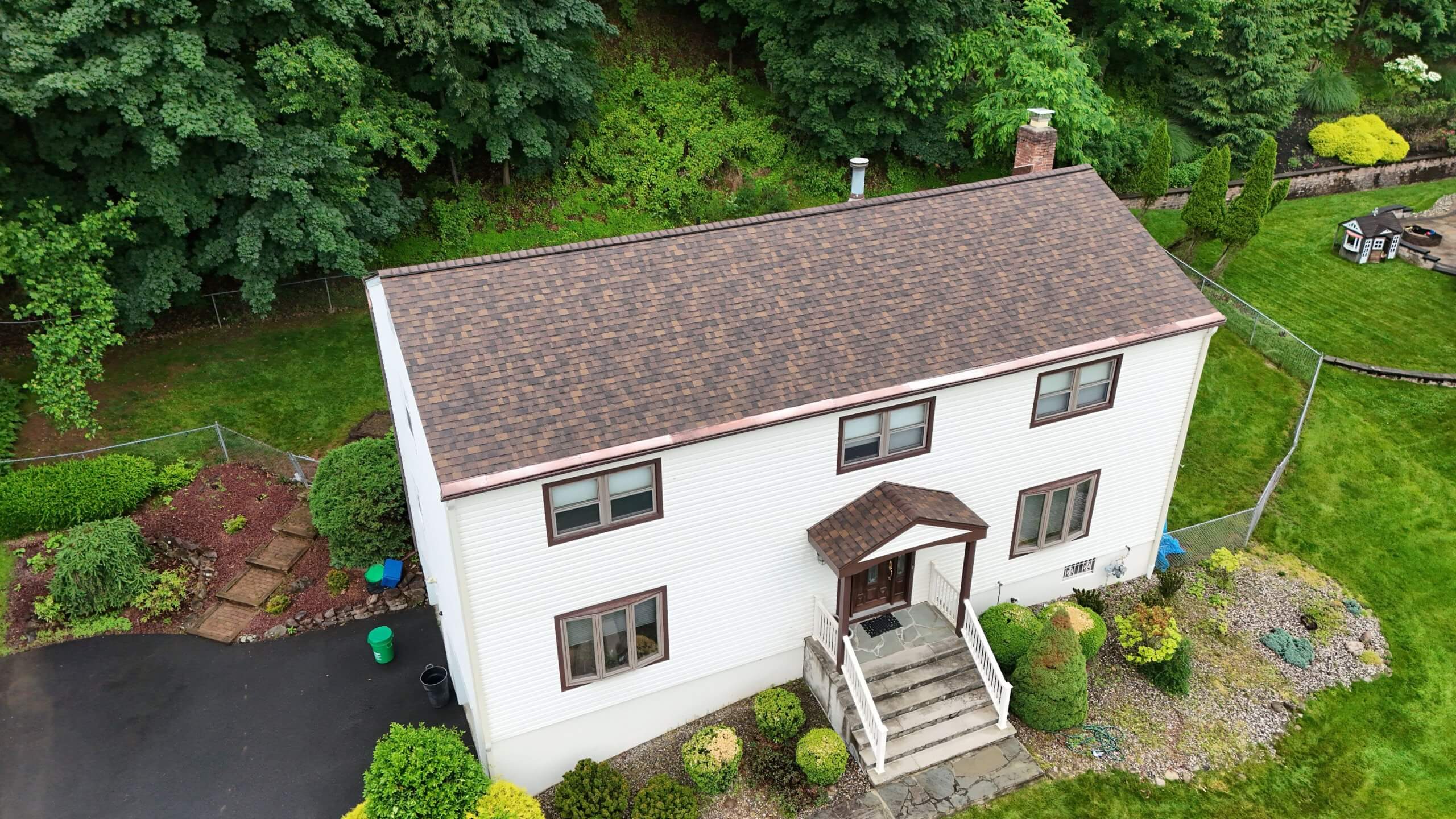
For Armonk’s residential market, replacement specifications include ice-and-water shield at all eaves and valleys per New York State code, dimensional architectural shingles or premium materials such as cedar shake and standing seam metal rated for the area’s wind and moisture exposure, and ridge vent installation where attic ventilation is deficient. We coordinate directly with homeowners association architectural committees where a property falls within a governed community.
Targeted repairs addressing specific failure points — individual shake replacement, skylight and dormer flashing rebuilding, valley flashing correction, isolated tree-fall damage, and storm-related repairs — without requiring full system replacement where the surrounding roof remains sound.
Repair is the right recommendation when it genuinely extends a sound system’s service life. On Armonk’s complex custom rooflines, distinguishing repair candidates from replacement candidates requires material-specific expertise — a well-maintained cedar shake roof with isolated moss damage on one shaded valley is a different repair decision than a 25-year-old shake system with systemic decay throughout the field.
Full residential and commercial roof inspections — all roof planes, every flashing point, gutters and drainage, skylights, chimneys, and attic conditions where accessible — with written findings, condition photographs, and remaining service life estimate.
For Armonk’s real estate market, pre-purchase inspections are especially valuable on the town’s large custom homes, where a dozen or more roof planes and material transitions make ground-level assessment unreliable. Post-storm inspections document tree-fall or wind damage within the timeframe New York insurance policies require for claim initiation.
Scheduled maintenance services — gutter and valley debris clearing, moss and algae treatment, flashing inspection and re-sealing, minor repair of developing issues, and condition reporting — designed to extend roof service life on Armonk’s tree-shaded, custom-built homes.
Given how much of Armonk’s roofing wear is driven by tree debris and shade rather than age alone, a fall maintenance visit — clearing gutters and valleys of leaf litter, confirming drainage, and treating early moss growth before winter — is the highest-value maintenance timing in this market.
Installation, repair, and maintenance of commercial flat and low-slope roofing systems — TPO, EPDM, and modified bitumen — for office, medical, and retail properties along Armonk’s Route 22 and King Street corridors.
North Castle’s commercial inventory near the IBM campus and along its main commercial corridors includes a mix of newer corporate construction and older buildings where deferred membrane maintenance has advanced systems toward end-of-life. Commercial projects include permit management through the North Castle Building Department’s commercial review process.
Every project at On Time Roofing of Armonk follows a clear, documented process from first contact through completion. The complexity of Armonk's custom rooflines and the town's permitting and HOA review requirements make process discipline especially important — here is exactly how it works.
Timeline: Same-day contact; inspection within 1–3 business days
You call, email, or submit online. We confirm your address, the nature of the problem, and schedule the inspection. For emergency situations — particularly active tree-fall or storm damage — we prioritize same-day or next-day response. For properties within Whippoorwill Club, Windmill Club, or other governed communities, we note this at intake so gate access and HOA review requirements are handled correctly from the start.
Customer expectations: No preparation needed. If you have any prior repair documentation, permit history, or HOA architectural approvals on file, having them available helps us understand the roof’s maintenance history.
Timeline: 45–120 minutes depending on property size and roof complexity
Our inspector systematically examines all roof planes, every flashing point, gutters and drainage, skylights and dormers, chimney and penetration conditions, attic access where available, and any visible interior symptoms the homeowner has noted. On Armonk’s large custom estates — particularly homes with a dozen or more roof planes, multiple skylights, or cedar shake systems — inspection takes meaningfully longer than on simpler suburban construction.
Armonk considerations: We note any HOA or architectural review requirements that apply to the property, which affects material options for any replacement scope. We document tree canopy conditions and identify any hazard limbs relevant to the roofing scope.
Customer expectations: Written findings report with photographs within 24 hours of inspection.
Timeline: Estimate delivered within 24–48 hours of inspection
We provide a written, itemized estimate detailing material specifications, labor, permit fees, disposal, and any deck or substrate work identified during inspection. For custom homes or those with HOA material requirements, we explain the specification rationale and any architectural review submission needed.
North Castle permit note: We confirm whether the specific project scope requires a North Castle building permit or HOA architectural approval, and include associated fees and estimated processing timeline in the estimate where applicable.
Timeline: Repairs: same-day or next-day. Residential replacements: 2–4 days depending on size and complexity. Commercial and large estate projects: 4–7 days.
Installation begins with property protection — perimeter tarps, magnetic nail sweepers along the drip line, and staging that accounts for long driveways and wooded access common on Armonk lots. On properties requiring limb clearance for safe roof access, we coordinate scheduling with an insured tree service ahead of installation. Deck findings during tear-off are communicated and discussed before any scope beyond the estimate proceeds.
New York weather consideration: We schedule around forecasted precipitation and don’t start tear-off we can’t fully protect before anticipated rain.
Timeline: Final walkthrough on completion day
Before the crew leaves, a supervisor inspects the full installation and confirms complete cleanup — including debris removal from lawns, driveways, and wooded perimeter areas common on Armonk’s larger properties. We conduct a walkthrough with the owner, provide written warranty documentation, and register manufacturer warranties on qualifying products.
Customer expectations: All debris removed same day. Permit and HOA inspection scheduling managed by us for qualifying projects.
On Time Roofing has spent more than a decade working specifically in Armonk’s roofing market — not as a regional contractor who occasionally takes North Castle calls, but as a company that has worked across the full spectrum of the town’s housing inventory: cedar shake estates in Whippoorwill, historic farmhouses along Bedford Road, contemporary skylight-heavy builds in Windmill Club, and corporate flat roofs along Route 22. That direct experience is what makes our inspection findings accurate, our material recommendations appropriate for what’s actually on the roof, and our permitting and HOA process knowledge reliable for North Castle’s specific requirements.
Armonk’s housing stock includes material types — cedar shake, standing seam metal, slate on older farmhouses, and complex multi-plane flashing systems — that many general roofing contractors encounter rarely and handle incorrectly. We have direct experience assessing whether an Armonk cedar shake system is worth continued repair or has reached end-of-life, how to detail flashing correctly across a dozen or more roof planes, and when a material upgrade makes sense for a homeowner prioritizing reduced maintenance. This is expertise built through years of working on specific Armonk properties, not through general training.
Every project On Time Roofing completes is backed by our New York State Home Improvement Contractor license, general liability insurance, and workers’ compensation coverage. On large, high-value Armonk properties, verified credentials and adequate insurance coverage matter more than on a standard suburban job. We provide certificate documentation before any project begins.
North Castle requires permits for most roofing replacement and structural repair work, and a meaningful share of Armonk properties also require HOA architectural committee approval before work can proceed. We manage the full permit submission process, track application status, coordinate any required architectural review, and schedule required inspections — so the approval process is our responsibility to manage, not something homeowners need to navigate independently.
Nor’easters, summer thunderstorms, and the tree-fall risk that comes with Armonk’s wooded lots produce roofing emergencies at the worst possible times. On Time Roofing maintains the crew capacity, material inventory, and tree service coordination to respond to emergency calls during peak storm seasons — not just to quote a project while water continues entering the building.
Our written workmanship warranty covers every installation and repair we perform. We register manufacturer warranties on qualifying shingle, shake, and metal roofing products and provide warranty documentation at project close. A warranty from a local contractor with an established Armonk presence is a meaningful protection — when warranty issues arise, the contractor who did the work is accessible, not routed through a national call center.

GAF has been producing shingles for over a century, leading the industry in quality, brand recognition, and innovative designs.

Owens Corning Offers Solutions for All Your Building and Remodeling Needs
On Time Roofing serves Armonk and the surrounding communities across a 20-mile service radius, bringing the same expertise in custom construction, wooded terrain, and New York regulatory requirements to every property we work on.
Our team proudly serves homeowners and businesses throughout the surrounding Westchester County region.
Standard asphalt shingle replacement on a custom colonial in Armonk typically runs $14,000–$20,000, and $24,000–$38,000 for complex multi-gable estate homes with dormers and skylights. Cedar shake replacement, common on the area's estate-style homes, runs $28,000–$45,000 depending on size and roof complexity. Commercial flat roof replacement along the Route 22 corridor runs $30,000–$48,000 for a mid-size scope. The higher end of these ranges reflects New York labor costs, permit and architectural review fees, and the roof complexity typical of Armonk's custom construction. Free inspection provides an accurate project-specific estimate.
Yes. The Town of North Castle requires building permits for roof replacements and most structural roof repairs through its Building Department. New York State also requires roofing contractors to hold a Home Improvement Contractor (HIC) license for residential work. If your property is within Whippoorwill Club, Windmill Club, or another HOA-governed community, architectural committee approval is typically required in addition to the town permit. On Time Roofing manages all permit applications, fee payments, HOA submissions where applicable, and inspection scheduling as part of every qualifying project.
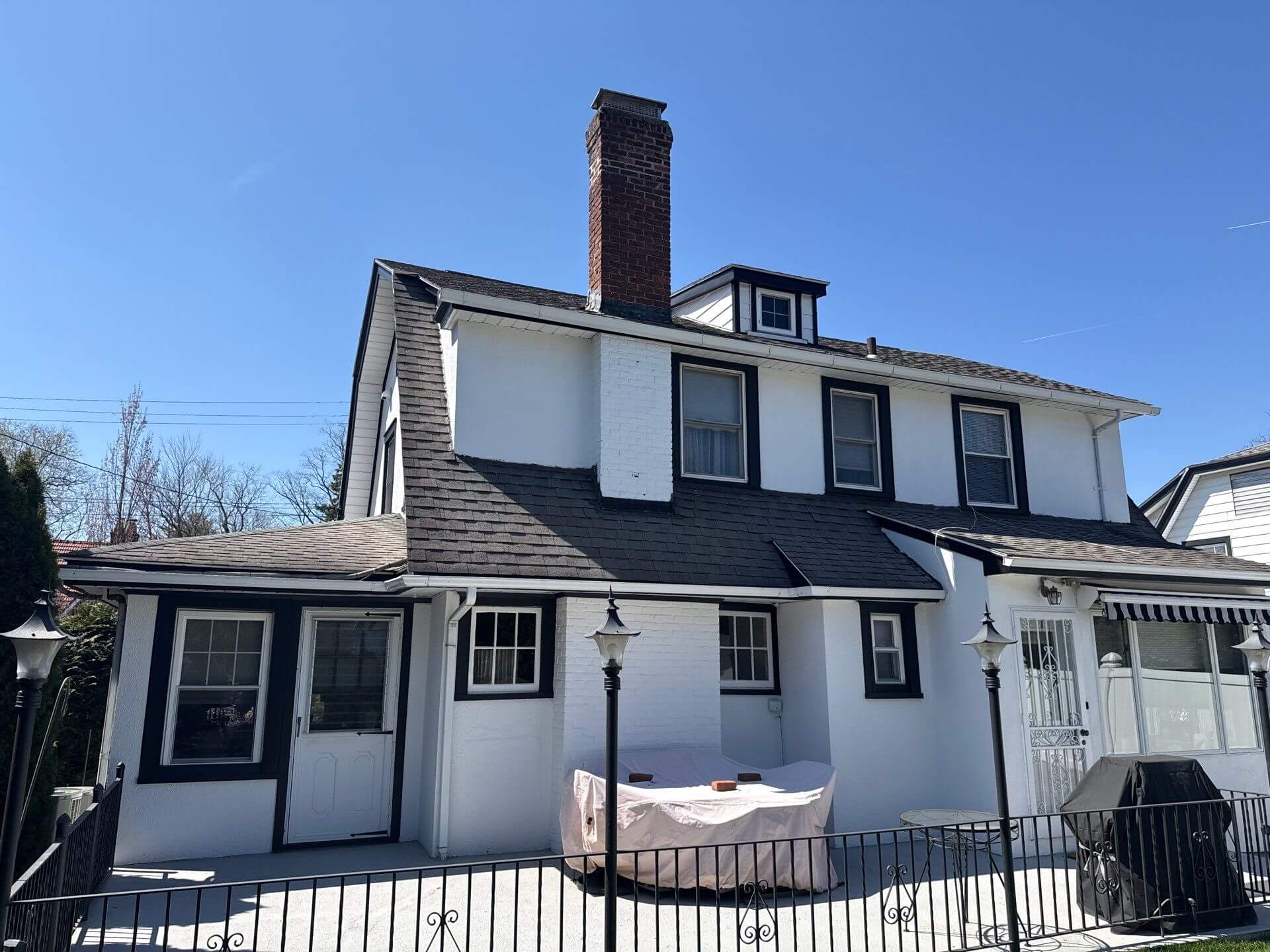
Armonk's ice dam pattern is driven primarily by tree canopy rather than attic heat loss. Heavily wooded lots keep large sections of roof — particularly north-facing valleys and dormers — in shade for much of the winter, so snow and ice on those sections persist and cycle through freeze-thaw long after open, sun-exposed roof planes have cleared. Complex custom rooflines with multiple valleys concentrate this effect further, since valleys collect more snow depth than a simple roof plane. This means ice dams can form even on newer, well-insulated homes if the roof geometry and tree cover concentrate shade in the right places.
Standard residential shingle replacements on a mid-size custom home typically complete in two to three days of installation work. Larger estate properties with multiple dormers, skylights, and complex rooflines run three to five days. Cedar shake and commercial membrane replacements typically run four to seven days depending on size. The overall project timeline includes permit processing — and, for HOA-governed properties, architectural review — which can add one to four weeks before installation begins. We provide a specific installation date at estimate confirmation and communicate proactively if anything changes.
This is one of the more common decisions Armonk homeowners face, and it depends on the specific system's condition, how much tree shade the roof receives, and how much ongoing maintenance the homeowner wants to take on. A well-maintained cedar shake roof on a lot with moderate tree exposure, with sound decking and regular moss treatment, can deliver decades of service life and remains a strong aesthetic and value choice for estate-style homes. A shake system on a heavily shaded lot that's showing systemic moss penetration and underlying deck moisture is a different conversation — for homeowners prioritizing lower maintenance, standing seam metal or a cedar-profile architectural shingle can deliver a comparable appearance with substantially less upkeep. Our inspection includes a specific recommendation on this question with documented evidence.
The key indicators are system age, the extent of current failure points, and whether those failures are isolated or symptomatic of systemic deterioration across the roof. A 10-year-old roof with an isolated tree-limb impact is a repair candidate. A 25-year-old cedar shake or asphalt system with widespread moss penetration, multiple active flashing leaks, and material degradation across most roof planes is a system that has reached end-of-life and is better replaced than repaired indefinitely. Our free inspection specifically addresses this question with documented evidence rather than a blanket recommendation.
Armonk’s wooded, hillside terrain doesn’t give roofs an obvious warning system between first signs of trouble and active failure — a shaded valley or a flashing point buried among a dozen roof planes can deteriorate for years before it’s visible from the ground. Whether you’ve noticed ceiling staining, moss buildup, storm damage, or your roof simply hasn’t been professionally inspected in years, we’re the right starting point.