Chappaqua roofs cover more architectural ground than almost any comparable Westchester community. As the commercial and commuter hub of the Town of New Castle, the hamlet grew in distinct waves — 19th-century fieldstone farmhouses along its rural roads, a Tudor Revival commercial district built up around the train station in the early 20th century, a wave of center-hall colonials constructed for Metro-North commuters in the 1950s and 60s, and a notable concentration of mid-century modern homes built with flat or very low-slope roofs that are still rare outside a handful of Westchester towns. Each of those building eras brought a different roof system, a different set of failure points, and a different maintenance need — which means a roofing approach built around any single housing type consistently underperforms here. On Time Roofing of Chappaqua has spent more than ten years working across this full range, developing the material expertise and local permitting knowledge that New Castle’s varied housing stock demands.
We know the difference between an original built-up flat roof on a 1960s modern home near Random Farms and the steep slate-look tile roofing on the Tudor Revival storefronts across from the Chappaqua train station. We know how a fieldstone farmhouse along Hardscrabble Road ages differently than a post-war colonial off King Street, and why the flashing detail that works on a Chappaqua Crossing retail building is the wrong specification for a low-slope residential roof a mile away. Serving Chappaqua, Millwood, Mount Kisco, and the broader New Castle and northern Westchester market, we bring the local material and regulatory knowledge that national chains and out-of-region contractors can’t replicate.
Chappaqua isn’t a single-era suburb, and its roofing needs aren’t either. The combination of the hamlet’s layered architectural history, its unusual concentration of flat-roof residential modernism, and New Castle’s permitting and historic-district oversight creates roofing demands that a contractor without direct local experience will consistently underestimate.
Chappaqua sits along the Saw Mill River corridor in central Westchester County, at a lower, more sheltered elevation than the hillier terrain to its north and east. That river-valley position brings its own weather pattern: higher humidity and fog retention along the river bottomlands, ground-level cold-air pooling on clear winter nights, and a snowfall total — typically 28–32 inches per season — that sits between the coastal Hudson communities and the higher-elevation towns further inland. The hamlet sees 25–35 freeze-thaw cycles in a typical winter, enough to stress aging flashing and roof edges without the extreme urban heat-island effect found closer to New York City. For Chappaqua’s flat and low-slope residential roofs — a genuinely uncommon feature outside a handful of Westchester’s mid-century modern enclaves — that freeze-thaw cycling interacts with ponding water in a way pitched roofs never encounter, making drainage and membrane condition the dominant maintenance concern rather than classic eave ice damming alone.
New Castle’s development history left Chappaqua with a genuinely layered housing inventory. Along King Street, Hardscrabble Road, and Roaring Brook Road, original fieldstone and clapboard farmhouses from the 1800s remain, many carrying slate roofing that has been repaired piecemeal for a century. The hamlet center around the Metro-North station retains a cluster of early-20th-century Tudor Revival commercial buildings with steep, complex rooflines finished in slate or slate-look tile. The post-war commuter boom added the center-hall colonials and capes that fill most of Chappaqua’s residential streets, typically built between 1945 and 1975 with asphalt shingle roofing now well past its original service life. And in developments including Random Farms and scattered custom lots throughout New Castle, Chappaqua carries one of Westchester’s more notable concentrations of mid-century modern residential architecture — homes built with flat or near-flat built-up or membrane roofs rather than the pitched shingle systems standard elsewhere in the county. Few roofing contractors regularly work across all four of these systems; we do.
Roofing work in Chappaqua operates within New Castle’s town permitting structure and, for a meaningful share of properties, an additional layer of design review. The Town of New Castle requires building permits for roof replacements and most structural repair work, administered through the New Castle Building Department, with standard residential processing typically running 2–4 weeks. Properties within the Chappaqua hamlet center’s historic commercial cluster near the train station may fall under design guidelines intended to preserve the district’s Tudor Revival character, affecting material and color choices on visible roof sections. Chappaqua Crossing — the mixed-use retail and residential redevelopment of the former Reader’s Digest campus — operates under its own property management standards for commercial roofing work. Insurance claims for storm or flood-adjacent damage along the Saw Mill River corridor involve New York State insurance regulations, and documentation requirements for New Castle homeowners’ and commercial policies warrant contractor experience with New York-specific claims handling.
After ten-plus years of roofing work across Chappaqua and the broader New Castle market, On Time Roofing has developed a clear picture of the failure patterns that appear most consistently on properties in this hamlet. Every problem below is driven by the specific combination of building era, material, and river-valley climate that defines the Chappaqua market.
Ice dams form when heat escaping through an inadequately insulated attic melts snow on the upper roof, which then refreezes at the colder eave overhang and builds into a barrier that forces meltwater back up under the shingles. Chappaqua’s dominant residential type — the center-hall colonial and cape built during the 1945–1975 commuter boom — was constructed to the insulation standards of its era, which fall well short of current attic performance expectations. Combined with 25–35 freeze-thaw cycles each winter, these homes are consistently among the highest-frequency ice dam calls in the New Castle market.
Signs you’ll notice:
Chappaqua-specific patterns: Original, unrenovated colonials on the hamlet’s older residential streets show the highest rate of ice dam calls, particularly where attic insulation hasn’t been upgraded since original construction. Homes with complex hip-and-valley rooflines concentrate ice formation at valley intersections more than simple gable roofs do.
Severity: Serious. Active ice dams can introduce several gallons of water per day into ceiling and wall assemblies. Address current-season ice dams and schedule an attic ventilation and insulation assessment for the following season.
Typical solution: Emergency ice dam removal using steam, followed by ice-and-water shield installation at eaves during any subsequent repair or replacement, and attic ventilation and insulation correction.
Chappaqua’s mid-century modern homes — concentrated in developments including Random Farms and scattered throughout New Castle’s custom-lot streets — were built with flat or very low-slope built-up or early membrane roofing, a design choice that defines the architectural style but creates a maintenance profile unlike anything else in the local housing stock. These original systems are now well past their intended service life, and even properly updated membrane replacements require ongoing drainage management that pitched roofs never need.
Signs you’ll notice:
Chappaqua-specific patterns: Original, unreplaced flat roofs on mid-century homes built before 1975 show the highest failure rates, particularly where clerestory windows or flat-roof skylights add additional penetration points. Homes where drainage was altered by later additions or landscaping changes frequently develop new ponding areas that weren’t part of the original design.
Severity: Serious to Emergency, depending on ponding extent and membrane condition. Flat roofs fail differently than pitched roofs — deterioration can be extensive before it becomes visible from the ground.
Typical solution: Full membrane assessment and drainage evaluation, targeted patch repair for isolated failures, or complete tear-off and replacement with a modern single-ply membrane system engineered for the home’s specific roof geometry and drainage requirements.
Chappaqua’s oldest properties — fieldstone and clapboard farmhouses along King Street, Hardscrabble Road, and Roaring Brook Road, some dating to the 1800s — frequently carry original or early-replacement slate roofing now well beyond a century old. As with any historic slate system, individual slates crack, slip from their nail hooks, or become porous with age, and decades of patch repairs using mismatched materials and deteriorated flashing create conditions that require systematic assessment rather than isolated fixes.
Signs you’ll notice:
Chappaqua-specific patterns: Farmhouse properties along Chappaqua’s older rural roads show the highest concentration of aged slate, often paired with lead flashing original to the home’s construction. Properties whose slate hasn’t been professionally assessed in 20+ years frequently present with systemic flashing failures alongside individual broken slates.
Severity: Moderate to Serious. Individual broken slates allow water entry; systemic flashing and batten deterioration can indicate full slate replacement is warranted rather than continued repair.
Typical solution: Slate replacement assessment by a contractor experienced with historic slate, replacement of broken individual slates where the system is otherwise sound, or full slate system replacement with a comparable dimensional shingle where the system has reached end-of-life.
The Tudor Revival commercial buildings clustered around the Chappaqua train station were built in the early 20th century with steep, complex rooflines and slate or slate-look tile finishes intended to establish the hamlet center’s architectural character — a character New Castle’s design guidelines still work to preserve. Nearly a century of service has left many of these roofs with deteriorated flashing, aged material, and the added complexity of storefront awnings, signage penetrations, and mixed-use second-floor occupancy that residential slate roofs don’t encounter.
Signs you’ll notice:
Chappaqua-specific patterns: Buildings directly facing the train station plaza see the highest volume of leak calls, largely due to the number of roof penetrations added over decades of changing tenant signage and equipment. Design guideline compliance is a consistent factor in scoping repair work on these properties.
Severity: Serious. Commercial leaks affect tenant operations and second-floor occupancy, and downtown storefront visibility makes deferred maintenance a business concern as well as a structural one.
Typical solution: Historic-appropriate slate or tile repair and flashing replacement coordinated with New Castle’s design guidelines, with full system replacement recommended where deterioration is systemic.
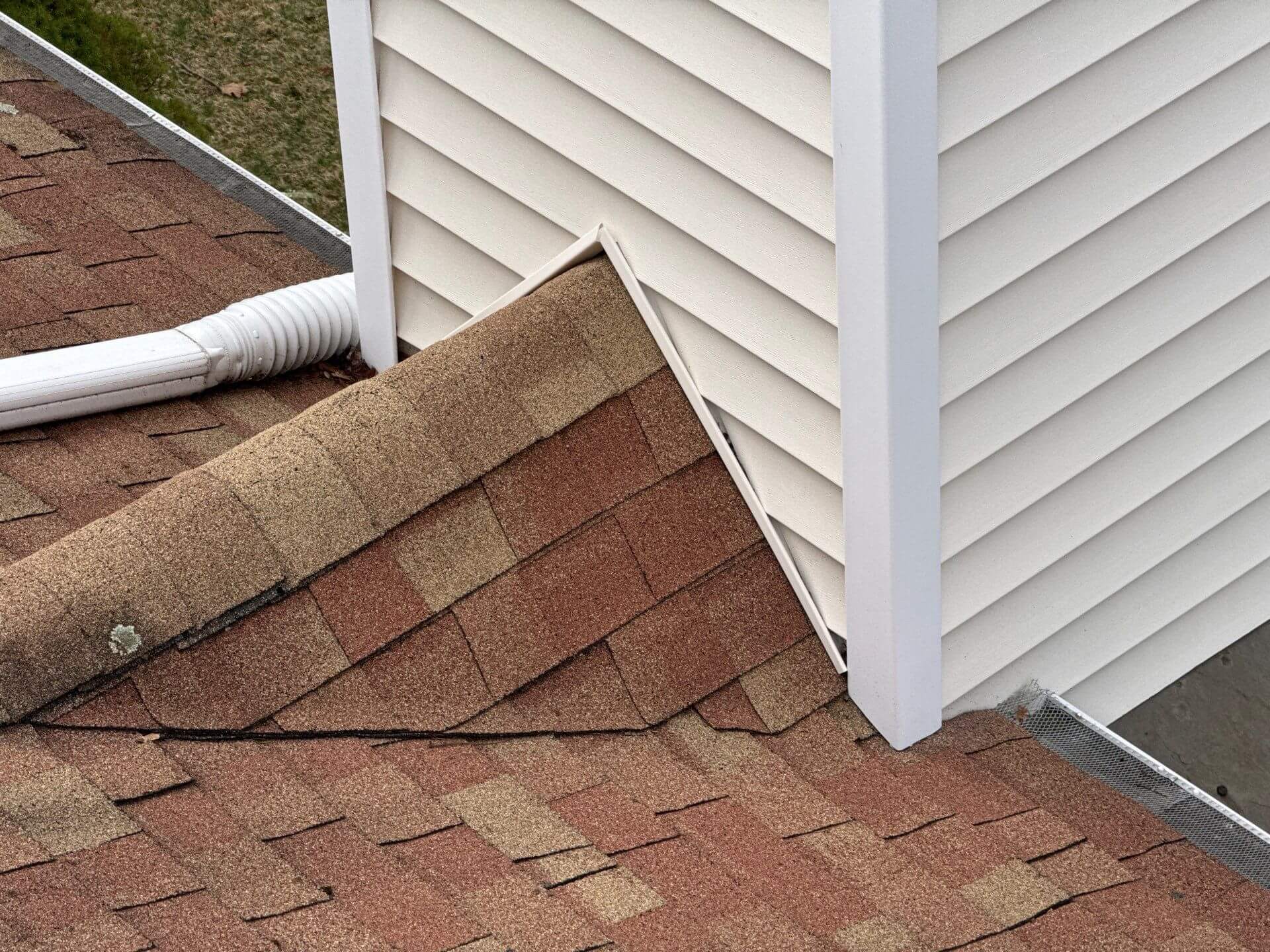
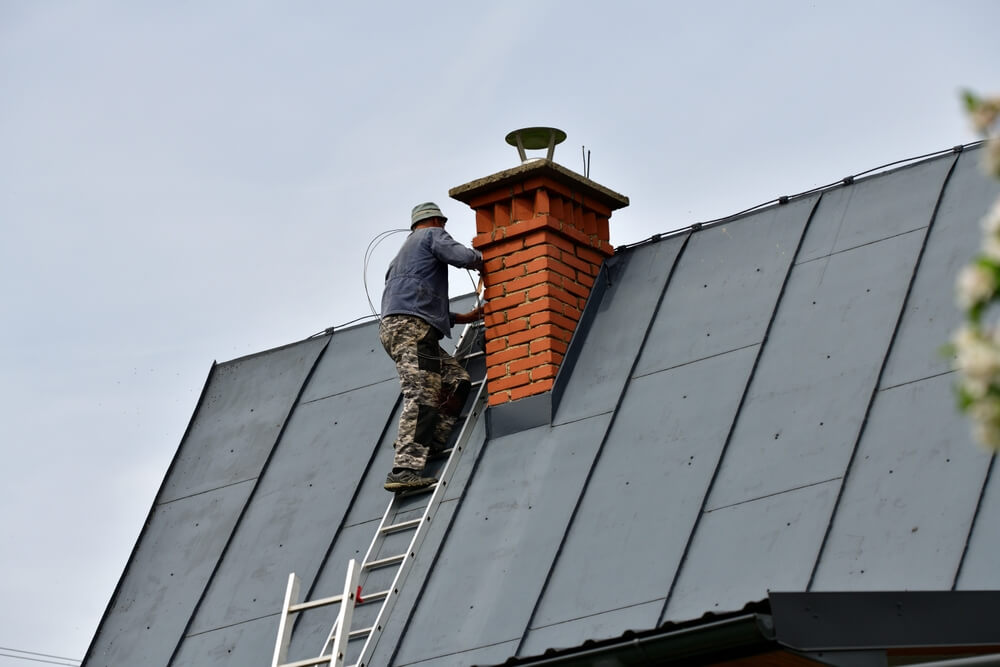
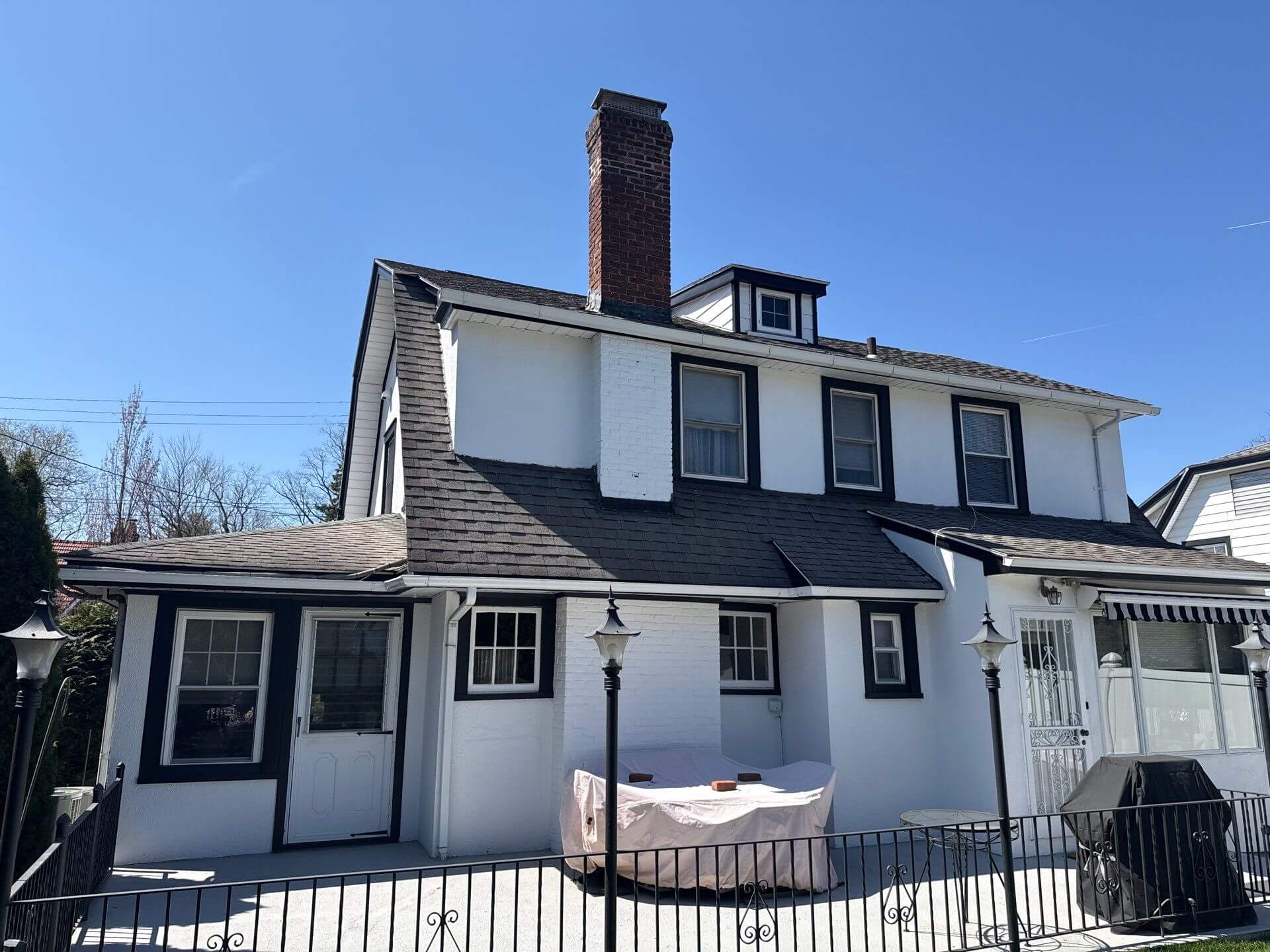
Chimney flashing failure occurs when the flashing at the chimney-to-roof junction corrodes, separates, or is lifted by ice, creating one of the most common single active leak sources across Chappaqua’s residential housing stock. Nearly every pre-1975 colonial, cape, and Tudor-style home in New Castle has at least one masonry chimney serving a fireplace or original heating system, and each one represents a flashing junction subject to decades of thermal cycling. This is distinct from the chimney’s masonry condition itself — flashing is a roofing detail, while the brick, mortar, cap, and crown are addressed separately as part of chimney repair work.
Signs you’ll notice:
Chappaqua-specific patterns: Original, unrenovated colonials with fireplace chimneys that have never had flashing replaced since original construction show the highest concentration of flashing-related leak calls. Tudor-style homes with decorative chimney stacks and multiple flashing transitions require more detailed repair work than a standard single-flue chimney.
Severity: Serious. Chimney flashing failures allow water infiltration with every rain event and frequently produce structural damage to rafters and decking adjacent to the chimney if left unaddressed.
Typical solution: Complete flashing removal and replacement using modern step flashing and counter-flashing systems, combined with a masonry chimney inspection to determine whether cap, crown, or tuckpointing work is also needed.
Wind damage describes shingle lifting, displacement, and blow-off caused by the Nor’easters and severe thunderstorms that move through the Saw Mill River valley, exposing roof decking and underlayment to direct water infiltration until repairs are completed. Chappaqua’s position along the river corridor brings a specific combination of exposure: open sightlines across the valley that funnel wind on certain streets, paired with mature tree cover on older residential lots that adds storm-debris risk on top of direct wind exposure.
Signs you’ll notice:
Chappaqua-specific patterns: Properties along the more open valley sections near the Saw Mill River show concentrated wind exposure during Nor’easter events, while wooded residential streets see a higher share of storm-related tree debris impact alongside wind-driven shingle loss.
Severity: Emergency. Wind-exposed deck areas allow large volumes of water entry during subsequent precipitation. Tarping and repair should be prioritized within hours of discovery.
Typical solution: Emergency tarping followed by shingle replacement with wind-resistant installation and seal-down of adjacent borderline shingles, or full replacement where wind damage is systemic.
On Time Roofing of Chappaqua provides the full spectrum of roofing services for a market as architecturally varied as New Castle demands — from single slate replacement on a King Street farmhouse to full flat-roof replacement on a Random Farms mid-century modern home. Every service is calibrated to the specific materials, building era, and regulatory requirements that Chappaqua properties require.
We provide emergency tarping, debris removal, and damage containment for active roof failures — storm damage, ice dam breaches, sudden flat-roof leaks, and any situation where a roof compromise is allowing immediate water entry. Emergency response is available throughout Chappaqua and the surrounding 20-mile service radius.
Emergency services include rapid-deploy tarping over exposed areas, photograph documentation for insurance purposes, and removal of debris creating ongoing damage risk. In New Castle’s Nor’easter season — November through March — emergency roofing demand spikes after every major storm event. We maintain response capacity during storm seasons to reach emergency calls within the same business day where conditions allow.
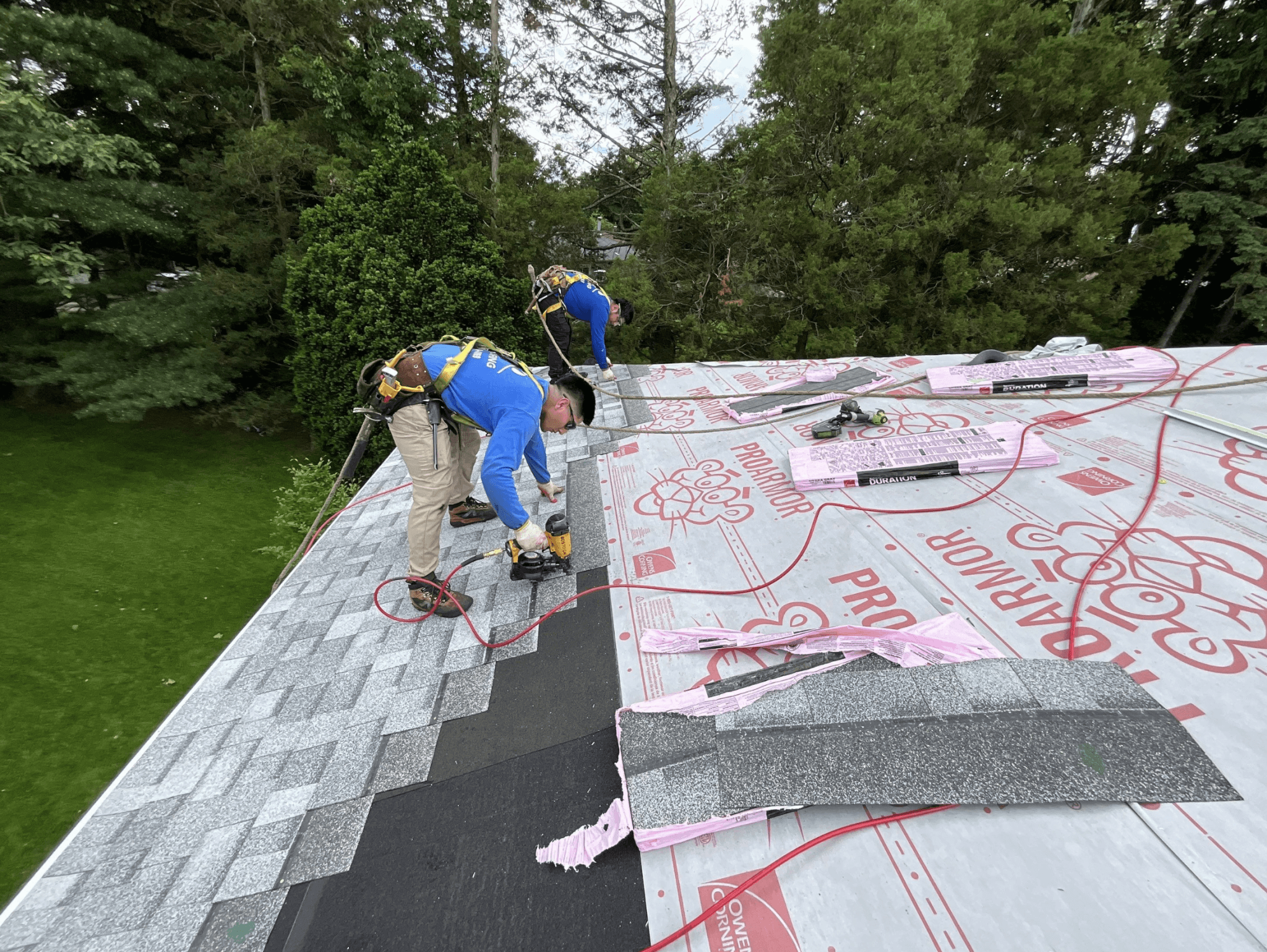
Full roof replacements from tear-off through finished installation — managing New Castle building permit applications, deck inspection and repair, underlayment appropriate for New York State’s climate requirements, and complete new shingle, slate, or flat-roof membrane installation.
For Chappaqua’s residential market, replacement specifications include ice-and-water shield at all eaves and valleys per New York State code, dimensional architectural shingles with minimum 130 mph wind resistance ratings, and ridge vent installation where attic ventilation is deficient. For flat-roof mid-century modern homes, we specify modern single-ply membrane systems engineered for the home’s specific drainage geometry. Where historic district or Chappaqua Crossing property standards apply, we manage the material approval process directly.
Targeted repairs addressing specific failure points — individual slate replacement, chimney flashing rebuilding, flat-roof membrane patching, isolated storm damage, and Tudor Revival flashing restoration — without requiring full system replacement where the surrounding system remains sound.
Repair is the right recommendation when it genuinely extends a sound system’s service life. On Chappaqua’s mixed housing stock, distinguishing repair candidates from replacement candidates requires material-specific expertise — a mid-century flat roof with an isolated seam failure is a different repair decision than one with systemic ponding across the field, and a farmhouse slate system with a few broken slates is a different call than one with widespread flashing failure.
Full residential and commercial roof inspections — all surfaces, flashings, chimneys, gutters, ventilation, drainage on flat roofs, and attic conditions — with written findings, condition photographs, and remaining service life estimate.
For Chappaqua’s real estate market, pre-purchase inspections are particularly valuable given how differently the hamlet’s four housing eras age — a flat-roof mid-century home and a fieldstone farmhouse require entirely different evaluation approaches. Post-storm inspections document damage within the timeframe New York insurance policies require for claim initiation.
Scheduled maintenance services — debris clearing, gutter cleaning, flat-roof drain clearing, flashing inspection and re-sealing, minor repair of developing issues, and condition reporting — designed to extend roof service life across Chappaqua’s varied housing stock.
Given the ice dam risk on the hamlet’s older colonials and the drainage sensitivity of its mid-century flat roofs, fall maintenance visits — clearing gutters and roof drains, confirming slope and drainage, and inspecting eave and parapet flashings before the first freeze — are the highest-value maintenance timing in this market.
Installation, repair, and maintenance of commercial flat and low-slope roofing systems — TPO, EPDM, and modified bitumen — for downtown Chappaqua’s Tudor Revival commercial buildings, the Chappaqua Crossing retail and mixed-use development, and other commercial properties throughout New Castle.
Chappaqua’s commercial inventory ranges from century-old mixed-use buildings near the train station to modern retail construction at Chappaqua Crossing, each with different roofing specifications and property-management standards. Commercial projects include permit management through the New Castle Building Department’s commercial review process.
Roofing rarely fails in isolation. Siding, gutters, and chimneys share the same exposure to Chappaqua’s freeze-thaw cycles, storm wind, and river-valley moisture, and problems in one system frequently show up as damage in another — a clogged gutter that backs up under the roof edge, a chimney crown that lets water into the flashing below, siding that traps moisture against a rotting fascia board. On Time Roofing handles all three alongside our core roofing work, so Chappaqua homeowners get one coordinated assessment and one crew instead of separate vendors working from separate, sometimes conflicting, diagnoses.
We install and repair vinyl, fiber cement, and wood-look siding systems across Chappaqua’s residential housing stock, from full siding replacement on aging center-hall colonials to targeted repair of storm-damaged or rotted sections on older farmhouses. Siding failures often trace back to a roofing or gutter issue — water shedding improperly at the roofline, or an overflowing gutter saturating the siding below — so our inspection evaluates the full exterior envelope rather than treating siding damage as an isolated problem.
Best for: Homeowners replacing siding at the same time as a roof project for coordinated color and material planning, storm-damaged siding sections requiring insurance-scoped repair, and older Chappaqua homes with wood siding showing rot near the roofline or foundation.
We install seamless aluminum gutter systems and repair or replace damaged gutters and downspouts, with particular attention to the drainage demands of Chappaqua’s ice dam-prone colonials and the internal roof drains on the hamlet’s flat-roof mid-century modern homes. Correctly sized and pitched gutters are one of the most cost-effective ways to reduce ice dam severity and prevent the foundation and siding damage that comes from water discharging too close to the house.
Best for: Homes with visibly sagging, overflowing, or pulled-away gutters, properties experiencing ice dam issues where gutter and downspout capacity is a contributing factor, and flat-roof homes needing drain and scupper maintenance as part of a broader roof plan.
Beyond the flashing work covered in our core roofing services, we handle the masonry side of chimney care — repointing and tuckpointing deteriorated mortar joints, rebuilding damaged chimney crowns and caps, and applying masonry waterproofing to extend the life of Chappaqua’s many original brick chimneys. This work is especially relevant on the hamlet’s pre-1975 colonials and historic farmhouses, where chimneys have often gone decades without masonry maintenance even when the roof around them has been replaced.
Best for: Chimneys with visible mortar deterioration, cracked or missing crowns, efflorescence staining, or masonry chimneys being addressed as part of a full roof replacement to avoid re-opening the same area for repairs shortly after roofing work is complete.
Every project at On Time Roofing of Chappaqua follows a clear, documented process from first contact through completion. The range of building types across New Castle and the town's permitting and design-review requirements make process discipline especially important — here is exactly how it works.
Timeline: Same-day contact; inspection within 1–3 business days
You call, email, or submit online. We confirm your address, the nature of the problem, and schedule the inspection. For emergency situations, we prioritize same-day or next-day response. For properties in the hamlet center’s historic commercial district or at Chappaqua Crossing, we note this at intake to ensure the right expertise and approval process is assigned.
Customer expectations: No preparation needed. If you have any prior repair documentation or permit history, having it available helps us understand the roof’s maintenance history.
Timeline: 45–90 minutes depending on property type and scope
Our inspector systematically examines all roof surfaces, every flashing point, gutters and drainage, chimney and penetration conditions, attic access where available, and any visible interior symptoms the homeowner has noted. Where siding, gutter, or chimney concerns are part of the visit, we assess those systems in the same appointment. On Chappaqua’s flat-roof mid-century homes and multi-chimney farmhouses, inspection includes drainage and ponding assessment or historic material evaluation not required on standard colonial roofs.
Chappaqua considerations: We note all permit history and any applicable historic district or Chappaqua Crossing design standards, which affects the scope of any replacement or structural repair project.
Customer expectations: Written findings report with photographs within 24 hours of inspection.
Timeline: Estimate delivered within 24–48 hours of inspection
We provide a written, itemized estimate detailing material specifications, labor, permit fees, disposal, and any deck or substrate work identified during inspection. For historic properties or those with design-guideline requirements, we explain the specification rationale in the estimate. Where roofing, siding, gutter, or chimney work is being scoped together, we itemize each so you can see exactly what’s driving the total cost.
New Castle permit note: We confirm whether the specific project scope requires a New Castle building permit and include permit fees and estimated processing timeline in the estimate where applicable.
Timeline: Repairs: same-day or next-day. Residential replacements: 1–3 days. Flat-roof, commercial, and complex multi-chimney projects: 2–5 days.
Installation begins with property protection — perimeter tarps, magnetic nail sweepers along the drip line, and careful material staging appropriate to the property. On flat-roof and commercial projects, we manage tenant access and building entry coordination with property managers or Chappaqua Crossing management. Deck findings during tear-off are communicated and discussed before any scope beyond the estimate proceeds.
New York weather consideration: We schedule around forecasted precipitation and don’t start tear-off we can’t fully protect before anticipated rain.
Timeline: Final walkthrough on completion day
Before the crew leaves, a supervisor inspects the full installation and confirms complete cleanup, including sidewalks and shared parking areas common around downtown Chappaqua’s commercial properties. We conduct a walkthrough with the owner, provide written warranty documentation, and register manufacturer warranties on qualifying products.
Customer expectations: All debris removed same day. Permit inspection scheduling managed by us for qualifying projects.
On Time Roofing has spent more than a decade working specifically in Chappaqua’s roofing market — not as a regional contractor who occasionally takes New Castle calls, but as a company that has worked across the hamlet’s full architectural range: fieldstone farmhouses on King Street, Tudor Revival storefronts near the train station, post-war colonials throughout the hamlet’s residential streets, and flat-roof mid-century modern homes in Random Farms and beyond. That direct experience is what makes our inspection findings accurate, our material recommendations appropriate for what’s actually on the roof, and our permit process knowledge reliable for New Castle’s specific requirements.
Few Westchester markets require fluency in as many distinct roofing systems as Chappaqua does — original slate, historic lead flashing, standard asphalt shingle, and flat built-up or membrane roofing on mid-century modern homes. We have direct experience assessing which system is on a given Chappaqua roof, whether a flat mid-century roof’s drainage issue is a design flaw or a maintenance failure, and when historic material preservation is the right call versus replacement with a modern high-performance alternative. This is expertise built through years of working on specific Chappaqua properties, not through general training.
Every project On Time Roofing completes is backed by our New York State Home Improvement Contractor license, general liability insurance, and workers’ compensation coverage. In a market where unlicensed work is common and its consequences — voided warranties, failed permit inspections, homeowner liability exposure — are real, verified credentials matter. We provide certificate documentation before any project begins.
Chappaqua requires permits for most roofing replacement and structural repair work, and a share of the hamlet’s downtown and historic properties carry additional design-guideline requirements. We manage the full permit submission process, coordinate any applicable design review, track application status, and schedule required inspections — so the approval process is our responsibility to manage, not something property owners need to navigate independently.
Nor’easters, ice dam events, and severe thunderstorms produce roofing emergencies at the worst possible times — and flat-roof failures in particular can escalate quickly once ponding water finds a weak seam. On Time Roofing maintains the crew capacity and material inventory to respond to emergency calls during peak storm seasons, whether the property is a colonial, a farmhouse, or a flat-roof modern home.
Our written workmanship warranty covers every installation and repair we perform, including siding, gutter, and chimney work completed alongside a roofing project. We register manufacturer warranties on qualifying shingle and membrane products and provide warranty documentation at project close. A warranty from a local contractor with an established Chappaqua presence is a meaningful protection — when warranty issues arise, the contractor who did the work is accessible, not routed through a national call center.

GAF has been producing shingles for over a century, leading the industry in quality, brand recognition, and innovative designs.

Owens Corning Offers Solutions for All Your Building and Remodeling Needs
On Time Roofing serves Chappaqua and the surrounding communities across a 20-mile service radius, bringing the same expertise in historic and mid-century housing stock, Northeast climate conditions, and New York regulatory requirements to every property we work on.
Our team proudly serves homeowners and businesses throughout the surrounding Westchester County region.
Standard asphalt shingle replacement on a typical Chappaqua colonial runs $11,000–$16,000. Flat roof replacement on the hamlet's mid-century modern homes runs $16,000–$26,000, reflecting the specialized membrane systems and drainage work these roofs require. Complex farmhouse and slate roof projects run $16,000–$25,000 depending on chimney count and roof geometry. Tudor Revival commercial roof repair in the hamlet center runs $8,000–$18,000 depending on scope. Free inspection provides an accurate project-specific estimate.
Yes. The Town of New Castle requires building permits for roof replacements and most structural roof repairs through its Building Department. New York State also requires roofing contractors to hold a Home Improvement Contractor (HIC) license for residential work. Properties within the hamlet center's historic commercial district or at Chappaqua Crossing may require additional design review. On Time Roofing manages all permit applications, fee payments, and inspection scheduling as part of every qualifying project.
Flat and low-slope roofs fail differently than pitched roofs. A patch repair addresses the specific point where water is currently entering, but ponding water and gradual membrane deterioration elsewhere on the roof can create new leak points even after a successful patch. Many of Chappaqua's original mid-century flat roofs are now well past their intended service life, and repeated isolated patching on an aging membrane system is often a sign that a full membrane assessment — and likely replacement — will resolve the problem more reliably than continued spot repair.
This depends on the specific slate system's condition, the grade and source of the original slate, the condition of the existing nail and batten system, and your goals for the property. Well-maintained original slate in good condition, with sound nails and flashing, is worth repairing — a quality slate system has decades of remaining service life. Slate that has become porous, whose nails are failing systemically, or that has been patched with mismatched materials over decades warrants an honest assessment of whether continued repair spending still makes sense versus replacement. Our inspection includes a specific recommendation on this question with documented evidence.
The key indicators are system age, the extent of current failure points, and whether those failures are isolated or symptomatic of systemic deterioration. A 12-year-old shingle roof with wind damage to a few courses after a Nor'easter is a repair candidate. A 25-year-old flat roof with recurring leaks in multiple locations, or a shingle roof with widespread granule loss and failed seal strips throughout the field, is a system that has reached end-of-life and is better replaced than repaired indefinitely. Our free inspection specifically addresses this question with documented evidence rather than a blanket recommendation.
Yes. Alongside our core roofing services, we install and repair siding, install and repair seamless gutters, and handle masonry chimney repair, rebuilding, and waterproofing. Since these systems share the same exposure to Chappaqua's weather and often fail together — a clogged gutter contributing to an ice dam, or a deteriorating chimney crown feeding water into the flashing below — having one contractor assess and address all of them tends to catch problems that a roofing-only inspection would miss.
Chappaqua’s mix of historic, mid-century, and post-war housing means developing roof problems can look very different depending on what’s actually on your roof — and ground-level observation rarely tells the full story on a flat roof or a century-old slate system. Whether you’ve noticed ceiling staining, standing water, missing slates, gutter overflow, or chimney deterioration, and whether your roof simply hasn’t been professionally inspected in years, we’re the right starting point.