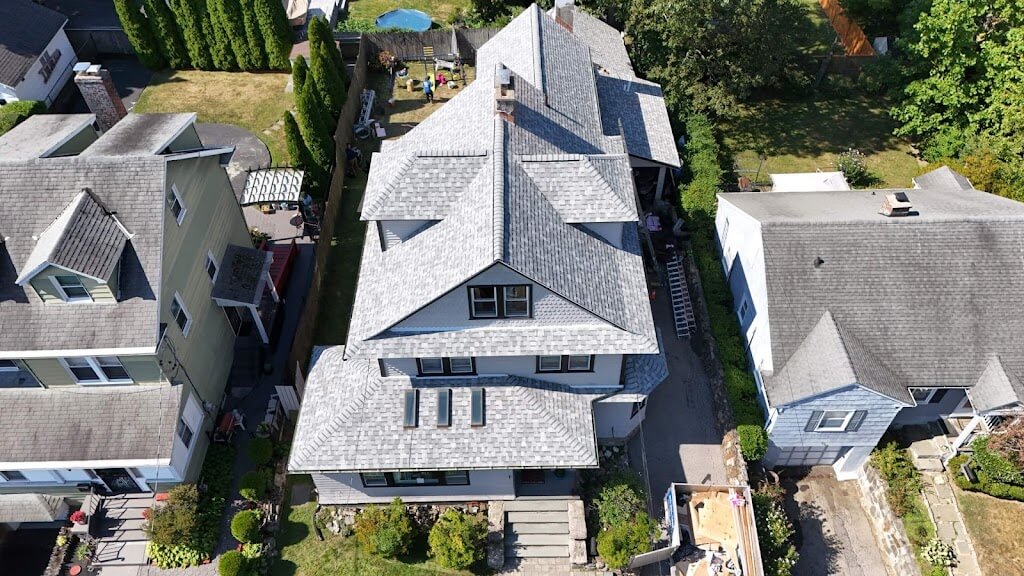
Drive from one end of Mount Vernon to the other and the roofing challenge changes completely. The city’s North Side — Fleetwood, Chester Hill, and the tree-lined streets around them — is built out with larger Victorian, Colonial Revival, and Tudor homes on generous lots, closer in character to a traditional Westchester suburb. Head south toward the Bronx border and the housing stock shifts entirely: dense blocks of the two-family “flat houses” that made Mount Vernon one of New York’s classic early-1900s streetcar suburbs, semi-attached and closely built, with a completely different set of roofing constraints. A roofing contractor who only knows one half of this city consistently misjudges the other. On Time Roofing of Mount Vernon has spent more than ten years working across both, building the material knowledge and access expertise that a genuinely split city like this one requires.
We know why an insulation and ventilation approach that works on a Fleetwood colonial doesn’t translate to a South Side two-family home with a fraction of the attic space and a shared party wall on both sides. We know how the rear additions and enclosed porches common across Mount Vernon’s flat houses fail differently than the main roofline, and why staging a roof job on a semi-attached South Side property takes a different plan than one on a standalone North Side lot with a full driveway. Beyond the roof, we handle the siding, gutter, and chimney work this city’s older housing stock needs just as often. Serving Mount Vernon, Bronxville, Pelham, and the broader southern Westchester and Bronx-border market, we bring the range of experience a divided city like Mount Vernon genuinely demands.
Mount Vernon isn’t one housing market — it’s two, sitting inside a single city boundary. The combination of the North Side’s larger, tree-shaded homes, the South Side’s dense two-family construction, and a citywide permitting process that has to serve both creates roofing demands that a contractor unfamiliar with this specific split will consistently misjudge.
Mount Vernon doesn’t have a single climate profile so much as two overlapping ones shaped by density and tree cover rather than distance. The North Side’s larger lots and mature tree canopy around Fleetwood and Chester Hill behave like a typical inland Westchester suburb — moderate freeze-thaw cycling, shaded rooflines that hold snow and ice longer in winter, and the ice dam risk that comes with it. The South Side, built out with minimal setbacks, smaller lots, and far less tree canopy so close to the Bronx border, retains summer heat more aggressively and gives roofing material less shade protection year-round — conditions that accelerate UV-driven shingle wear even as winter ice dam risk runs somewhat lower than on the North Side’s shadier streets. A roofing specification built around one half of the city routinely underperforms on the other.
Mount Vernon’s development history explains its split character directly. The North Side grew as a comfortable early commuter suburb, and Fleetwood and Chester Hill still carry the larger Victorian, Colonial Revival, and Tudor homes built for that market between the 1890s and 1930s, many with generous attics and standard pitched rooflines. The South Side tells a different story: Mount Vernon became one of the New York area’s classic streetcar suburbs for factory and rail workers commuting into the city, and its blocks were built out with an unusually high concentration of two-family “flat houses” — semi-attached homes with minimal side-yard clearance, shallow-pitch main roofs, and rear additions or enclosed porches added over decades, each with its own small flat or low-slope roof section. Downtown Mount Vernon’s Gramatan Avenue and Fourth Avenue commercial corridor adds a third category entirely — mixed-use buildings with flat commercial roofing over street-level retail. Few roofing contractors work comfortably across all three; we do.
Roofing work in Mount Vernon operates within a single City of Mount Vernon permitting structure that nonetheless has to account for genuinely different building types across its footprint. The City’s Building Department administers permits for roof replacement and structural repair work citywide, with standard residential processing typically running 2–4 weeks. Properties within the Chester Hill Historic District face additional design review intended to preserve the neighborhood’s original architectural character, a consideration that doesn’t apply to South Side flat-house replacement work. Insurance claims for storm damage or structural issues on Mount Vernon’s older two-family housing stock involve New York State insurance regulations, and documentation requirements warrant contractor experience with New York-specific claims handling on both larger single-family properties and denser multi-unit homes.
After ten-plus years of roofing work across both sides of Mount Vernon, On Time Roofing has developed a clear picture of the failure patterns that appear most consistently in this city. Every problem below traces back to the specific building type and neighborhood conditions where it shows up most.
Ice dams form when heat escaping through an inadequately insulated attic melts snow on the upper roof, which refreezes at the colder eave and builds into a barrier that forces meltwater back under the roofing material. In Mount Vernon, this problem shows up unevenly across the city: North Side homes in Fleetwood and Chester Hill, with larger attics and more tree-shaded rooflines, see classic ice dam formation at eaves and valleys. South Side flat houses, with minimal attic space and shallower roof pitches, see a different pattern — less pronounced ice damming but faster overall roof wear from direct sun exposure and heat retention during the rest of the year.
Signs you’ll notice:
Mount Vernon-specific patterns: Fleetwood and Chester Hill homes with mature tree cover and larger attics show the classic ice dam pattern most often. South Side two-family homes show comparatively less ice damming but higher rates of heat-accelerated shingle wear given their more open, less shaded rooflines.
Severity: Serious. Active ice dams can introduce several gallons of water per day into ceiling and wall assemblies. Address current-season ice dams and schedule an attic ventilation and insulation assessment for the following season.
Typical solution: Emergency ice dam removal using steam, followed by ice-and-water shield installation at eaves during any subsequent repair or replacement, with insulation and ventilation correction scoped to the home’s specific attic configuration.
Mount Vernon’s South Side carries an unusually high concentration of early-20th-century two-family “flat houses” — semi-attached homes built for streetcar-era factory and rail workers, typically with a shallow-pitch main roof and minimal attic clearance compared to the larger single-family homes found elsewhere in the city. These homes were built to a practical, cost-conscious standard rather than a premium one, and much of the original roofing material is now well past its intended service life, often patched multiple times rather than fully replaced.
Signs you’ll notice:
Mount Vernon-specific patterns: South Side flat houses that have never had a full roof replacement, only successive patch repairs over decades, show the highest concentration of leak calls. Because these homes are semi-attached, roof problems often need to be coordinated with the neighboring property owner when they originate near a shared wall.
Severity: Moderate to Serious. Two-family homes mean a single roof failure can affect two households, and minimal attic space means less buffer before water damage reaches living space.
Typical solution: Full roof assessment addressing both the shallow main roofline and any patch history, with replacement specifications suited to the home’s limited attic ventilation, and coordination with the adjoining property owner where a party-wall issue is involved.
Many of Mount Vernon’s two- and three-family homes have accumulated rear additions and enclosed porches over decades of ownership, and these additions are almost always built with their own small flat or low-slope roof section, separate from the home’s main pitched roofline. These sections are easy to overlook during general roof maintenance because they’re smaller and less visible from the street, and they carry drainage considerations a pitched-roof inspection alone won’t catch.
Signs you’ll notice:
Mount Vernon-specific patterns: Older two-family homes throughout the South Side with additions built well after original construction show the highest incidence of this problem, particularly where the addition’s roof has never been replaced despite work having been done on the main roof.
Severity: Moderate to Serious. These leaks are frequently mistaken for main-roof problems, which delays the correct repair and can allow structural damage to the addition itself.
Typical solution: Dedicated flat-roof assessment and membrane replacement scoped separately from the main roof, with drainage correction where the addition’s original construction didn’t adequately account for water shedding.
Granule loss and UV-driven shingle degradation happen everywhere over time, but the pace differs sharply across Mount Vernon depending on tree cover. The South Side’s dense development pattern, built with minimal setbacks and little room for mature street trees, leaves roofing material with far less natural shade than the North Side’s leafier blocks — meaning shingles here take direct sun exposure for more of the day, most of the year.
Signs you’ll notice:
Mount Vernon-specific patterns: South Side properties on streets with minimal tree canopy show measurably faster granule loss than comparably aged roofs in Fleetwood or Chester Hill, even when the shingle product and installation date are otherwise identical.
Severity: Moderate to Serious. End-of-life granule exhaustion indicates replacement planning is needed sooner than a roof’s stated age alone would suggest on these low-canopy streets.
Typical solution: Full roof replacement with dimensional architectural shingles carrying strong UV and heat resistance ratings, with attic ventilation improvements to offset the added heat load these homes experience.
Chimney flashing failure — corrosion, separation, or ice-driven lifting of the flashing where a chimney meets the roof — is common across older housing everywhere, but Mount Vernon’s semi-attached two-family construction adds a specific complication: many chimneys and roof valleys sit directly along or near a shared party wall, meaning a flashing failure can affect both halves of a semi-attached property, and any repair has to account for the neighboring owner’s roof section as well.
Signs you’ll notice:
Mount Vernon-specific patterns: South Side two-family homes with chimneys positioned near the party wall show the highest concentration of flashing-related leak calls that require coordination between adjoining property owners. North Side single-family homes with standalone chimneys don’t face this same coordination requirement.
Severity: Serious. Chimney flashing failures allow water infiltration with every rain event and frequently produce structural damage to rafters and decking if left unaddressed, with added complexity when the fix requires neighboring property cooperation.
Typical solution: Complete flashing removal and replacement using modern step flashing and counter-flashing systems, with clear communication and, where needed, coordinated scheduling between adjoining property owners on semi-attached homes.
Downtown Mount Vernon’s Gramatan Avenue and Fourth Avenue commercial corridor carries a mix of early-20th-century mixed-use buildings with retail at street level and residential or office space above, most relying on flat or low-slope roofing that’s frequently decades old. These buildings face many of the same failure patterns as residential flat roofs, compounded by the added complexity of tenant occupancy and rooftop equipment serving multiple business types.
Signs you’ll notice:
Mount Vernon-specific patterns: Mixed-use buildings along Gramatan and Fourth Avenue with rooftop HVAC added or upgraded over the years show accelerated wear at penetration points, and many of these buildings have never had a full membrane replacement since original construction.
Severity: Serious to Emergency. Active membrane failures in occupied commercial or residential space represent both a property damage and tenant liability concern.
Typical solution: Full membrane assessment, drain clearing and slope correction where standing water is present, targeted repair for isolated failures, or full tear-off and replacement for systems past useful service life.
On Time Roofing of Mount Vernon provides the full spectrum of roofing services for a city split between larger North Side homes and dense South Side two-family construction — from a Fleetwood colonial’s full reroof to flat-roof addition repair on a South Side two-family. Every service accounts for the specific building type and access conditions each Mount Vernon property presents.
We provide emergency tarping, debris removal, and damage containment for active roof failures — storm damage, sudden two-family leaks affecting both units, and any situation where a roof compromise is allowing immediate water entry. Emergency response is available throughout Mount Vernon and the surrounding 20-mile service radius.
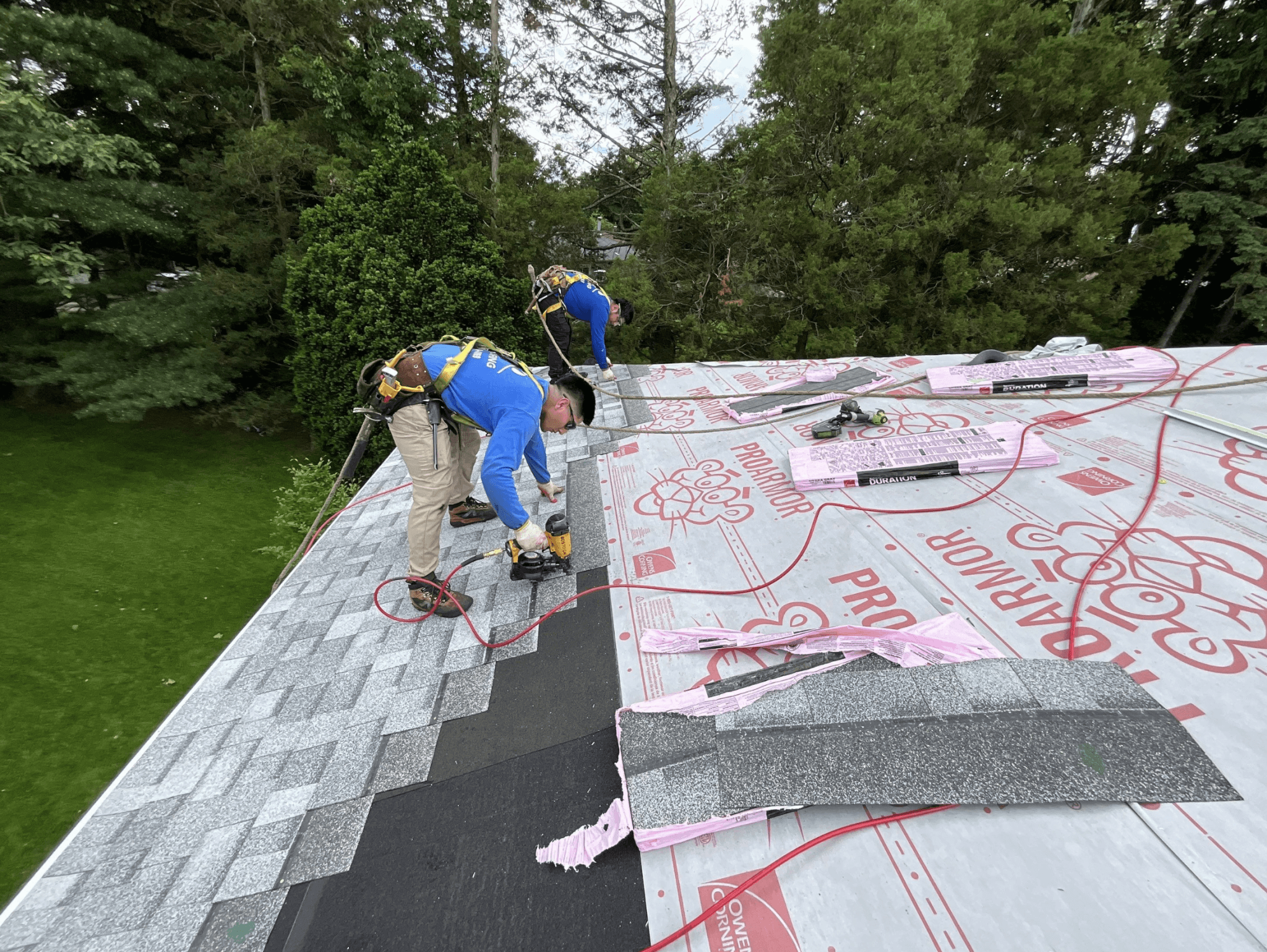
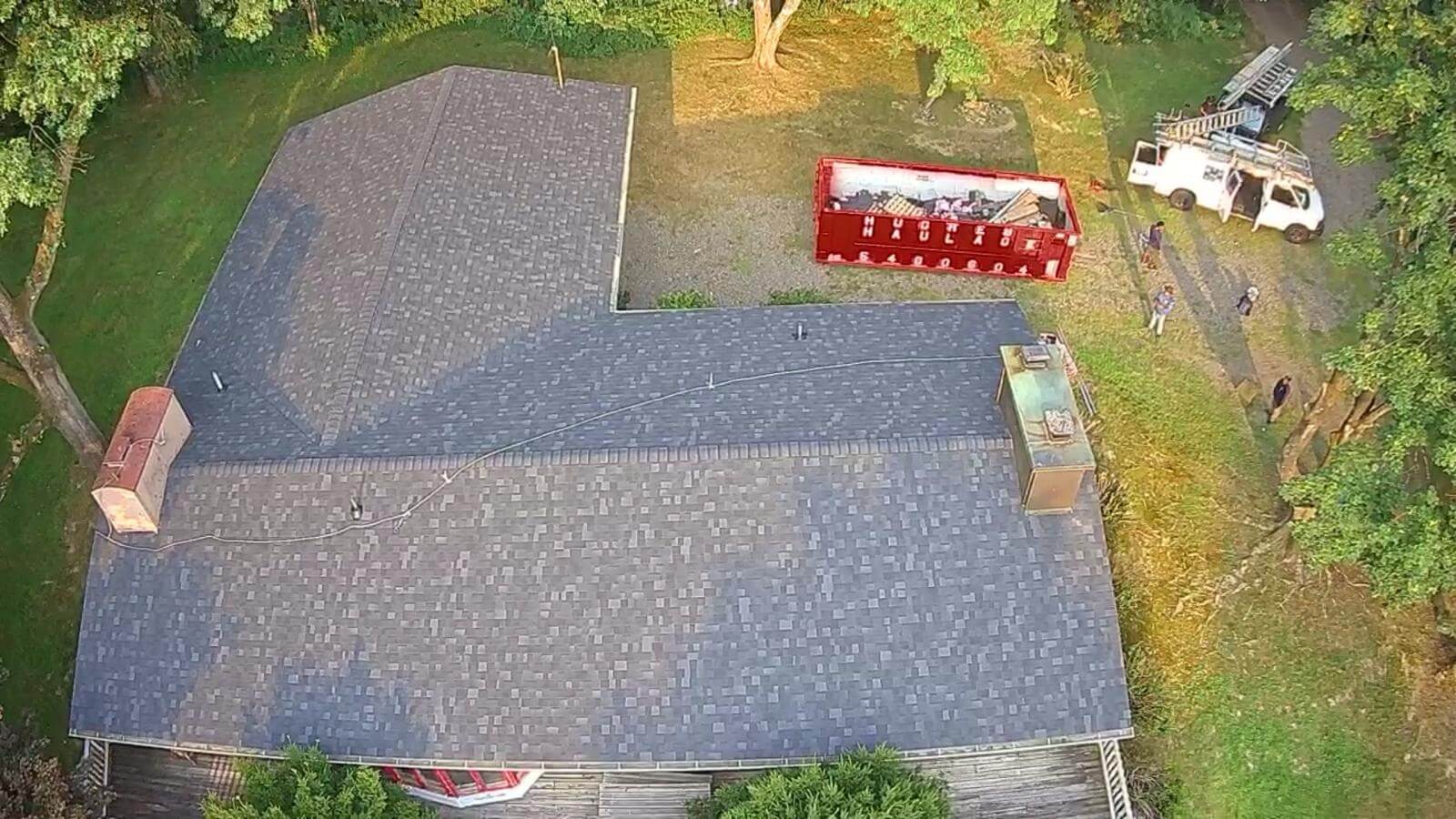
Full roof replacements from tear-off through finished installation — managing City of Mount Vernon building permit applications, deck inspection and repair, underlayment appropriate for New York State’s climate requirements, and complete new shingle or membrane installation, scoped to the specific home type.
Targeted repairs addressing specific failure points — chimney flashing rebuilding, flat-roof membrane patching on additions, isolated storm damage, and party-wall flashing coordination — without requiring full system replacement where the surrounding system remains sound.
Full residential and commercial roof inspections — all surfaces, flashings, chimneys, gutters, ventilation, and attic conditions — with written findings, condition photographs, and remaining service life estimate, calibrated to whether a property is a larger North Side home or a denser South Side two-family.
Scheduled maintenance services — debris clearing, gutter cleaning, flashing inspection and re-sealing, minor repair of developing issues, and condition reporting — designed to extend roof service life whether the property is a North Side single-family home or a South Side two-family.
Installation, repair, and maintenance of commercial flat and low-slope roofing systems — TPO, EPDM, and modified bitumen — for the mixed-use and retail buildings along Gramatan Avenue, Fourth Avenue, and downtown Mount Vernon’s surrounding commercial streets.
Roof problems in Mount Vernon rarely stop at the roofline, especially on the city’s older two-family homes where roofing, siding, gutters, and chimneys have often aged together without coordinated maintenance. A failing gutter that overflows onto siding below, or a deteriorating chimney that feeds water into flashing already under stress, shows up as damage in more than one system at once. On Time Roofing handles siding, gutters, and chimney work alongside our core roofing services, so Mount Vernon homeowners and landlords get one coordinated assessment instead of separate vendors working from separate diagnoses.
We install and repair vinyl, fiber cement, and wood siding across Mount Vernon’s residential housing stock, from full siding replacement on North Side Victorian and Colonial Revival homes to targeted repair on South Side two-family properties. Siding failures on older two-family homes often trace back to a roofing or gutter issue upstream, so our inspection evaluates the full exterior rather than treating siding damage in isolation.
Best for: Homeowners planning siding work alongside a roof replacement, landlords addressing siding across both units of a two-family property, and storm-damaged siding sections requiring insurance-scoped repair.
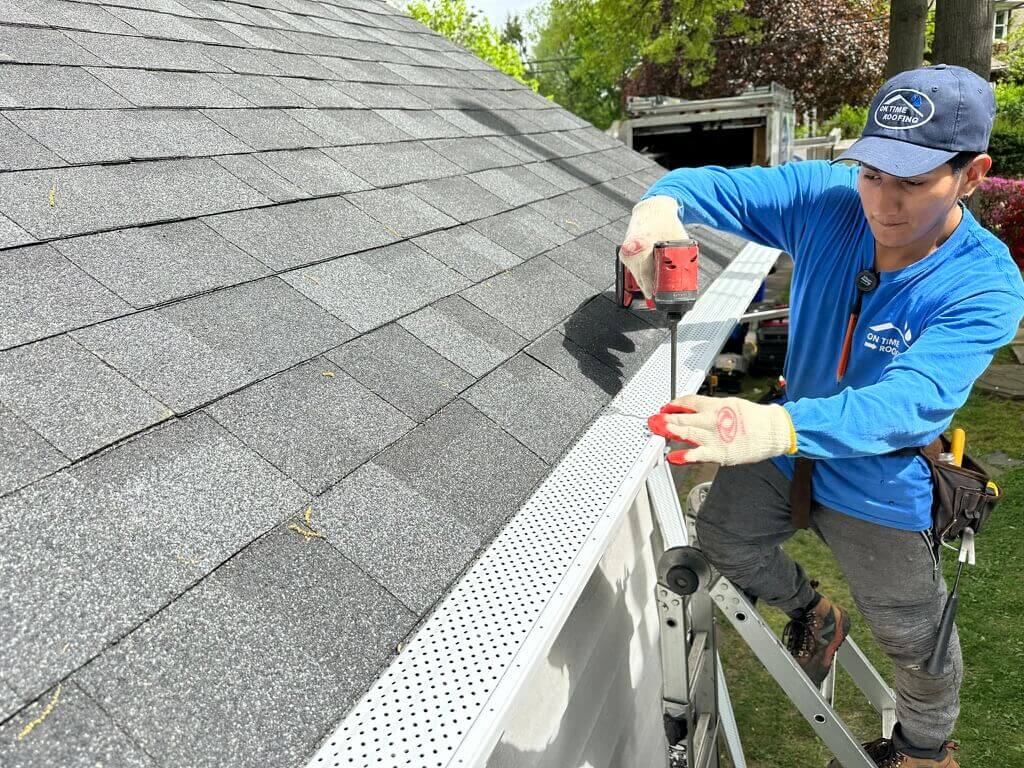
We install seamless aluminum gutter systems and repair or replace damaged gutters and downspouts, with attention to the tight lot spacing common on Mount Vernon’s semi-attached South Side homes, where gutter and downspout placement has to account for a neighboring property just a few feet away.
Best for: Homes with sagging, overflowing, or pulled-away gutters, two-family properties where gutter capacity is contributing to ice dam or foundation moisture issues, and landlords coordinating gutter maintenance across rental properties.
Beyond flashing work covered as part of our roofing services, we handle the masonry side of chimney care — repointing deteriorated mortar joints, rebuilding damaged crowns and caps, and applying masonry waterproofing. This work carries particular importance on Mount Vernon’s semi-attached two-family homes, where a shared or closely spaced chimney affects both halves of the property.
Best for: Chimneys with visible mortar deterioration, cracked or missing crowns, or efflorescence staining, and party-wall chimneys being addressed alongside a full roof replacement to avoid reopening finished work shortly after completion.
Every project at On Time Roofing of Mount Vernon follows a clear, documented process from first contact through completion. The differences between North Side and South Side properties, and the coordination that semi-attached homes sometimes require, make process discipline especially important — here is exactly how it works.
Timeline: Same-day contact; inspection within 1–3 business days
You call, email, or submit online. We confirm your address, whether the property is single-family or two-family, and the nature of the problem, then schedule the inspection. For emergency situations, we prioritize same-day or next-day response. For properties within Chester Hill, we note this at intake to ensure the right historic district expertise is assigned.
Customer expectations: No preparation needed. If you have prior repair documentation or permit history, having it available helps us understand the roof’s maintenance history.
Timeline: 45–90 minutes depending on property type and access
Our inspector systematically examines all roof surfaces, every flashing point, gutters and drainage, chimney and penetration conditions, attic access where available, and any visible interior symptoms reported. On South Side two-family homes, inspection includes an assessment of party-wall conditions and any coordination that repair work might require with the neighboring property. On North Side homes, we evaluate attic insulation and ventilation as part of the standard inspection.
Mount Vernon considerations: We note any Chester Hill Historic District requirements and flag where a repair may require communication with an adjoining property owner.
Customer expectations: Written findings report with photographs within 24 hours of inspection.
Timeline: Estimate delivered within 24–48 hours of inspection
We provide a written, itemized estimate detailing material specifications, labor, permit fees, disposal, and any deck or substrate work identified during inspection. For two-family properties, we clearly indicate where a scope item affects a shared wall or chimney and may require coordination with a neighboring owner.
City permit note: We confirm whether the specific project scope requires a City of Mount Vernon building permit and include permit fees and estimated processing timeline in the estimate where applicable.
Timeline: Repairs: same-day or next-day. Single-family replacements: 1–2 days. Two-family, party-wall, and commercial projects: 2–4 days.
Installation begins with property protection — perimeter tarps, magnetic nail sweepers along the drip line, and staging planned around Mount Vernon’s tighter lot spacing, particularly on South Side semi-attached properties. On commercial buildings, we coordinate tenant access with property managers. Deck findings during tear-off are communicated and discussed before any scope beyond the estimate proceeds.
New York weather consideration: We schedule around forecasted precipitation and don’t start tear-off we can’t fully protect before anticipated rain.
Timeline: Final walkthrough on completion day
Before the crew leaves, a supervisor inspects the full installation and confirms complete cleanup, including any shared driveways or walkways common on semi-attached South Side properties. We conduct a walkthrough with the owner, provide written warranty documentation, and register manufacturer warranties on qualifying products.
Customer expectations: All debris removed same day. Permit inspection scheduling managed by us for qualifying projects.
On Time Roofing has spent more than a decade working specifically in Mount Vernon’s roofing market — not as a regional contractor who occasionally takes city calls, but as a company that understands the real difference between a Fleetwood colonial and a South Side two-family flat house, and treats each appropriately rather than applying a one-size approach to a city that genuinely has two.
Mount Vernon’s unusually high concentration of two-family “flat houses” requires specific expertise most roofing contractors never develop — how these homes’ shallow-pitch roofs and minimal attics behave differently than standard single-family construction, and how to handle repairs that touch a shared party wall or chimney without creating friction between neighboring owners. This is expertise built through years of working on Mount Vernon properties specifically.
Every project On Time Roofing completes is backed by our New York State Home Improvement Contractor license, general liability insurance, and workers’ compensation coverage, appropriate for single-family residential work, two-family properties, and commercial scopes alike. We provide certificate documentation before any project begins.

GAF has been producing shingles for over a century, leading the industry in quality, brand recognition, and innovative designs.

Owens Corning Offers Solutions for All Your Building and Remodeling Needs
On Time Roofing serves Mount Vernon and the surrounding communities across a 20-mile service radius, bringing the same expertise in varied housing stock, New York climate conditions, and city permitting requirements to every property we work on.
Standard asphalt shingle replacement on a North Side single-family home runs $9,500–$13,500. Roof replacement on a South Side two-family flat house runs $12,000–$17,500, reflecting the shallow-pitch construction and ventilation work these homes often need. Flat roof replacement on a rear addition or enclosed porch runs $4,500–$9,000. Commercial flat roof replacement along Gramatan or Fourth Avenue runs $18,000–$28,000 for a mid-size building. Free inspection provides an accurate project-specific estimate.
Yes. The City of Mount Vernon requires building permits for roof replacements and most structural roof repairs through its Building Department. New York State also requires roofing contractors to hold a Home Improvement Contractor (HIC) license for residential work. Properties within the Chester Hill Historic District require additional design review for exterior material changes. On Time Roofing manages all permit applications, fee payments, and inspection scheduling as part of every qualifying project.
It depends on exactly where the problem originates and whether the repair requires access to or work on the adjoining property's roof section. Many party-wall chimney and flashing issues on Mount Vernon's semi-attached homes can be addressed entirely from your own property, but some require communication or coordinated scheduling with the neighboring owner. Our inspection identifies which situation applies and we handle that coordination as part of the project wherever possible.
Tree cover and roof pitch make a real difference. Mount Vernon's South Side has considerably less mature tree canopy than Fleetwood and Chester Hill, which means South Side roofs take more direct sun exposure throughout the year. That accelerates granule loss and general shingle aging compared to a similarly aged roof shaded by mature trees on the North Side, even when the shingle product itself is identical.
The key indicators are system age, the extent of current failure points, and whether those failures are isolated or symptomatic of systemic deterioration — and this applies whether the home is a North Side single-family property or a South Side two-family. A 10-year-old roof with isolated storm damage is a repair candidate. A 25-year-old roof with multiple active leak points and widespread granule loss, or a two-family home that's only ever received patch repairs, is a system that has reached end-of-life and is better replaced than repaired indefinitely. Our free inspection specifically addresses this question with documented evidence rather than a blanket recommendation.
Mount Vernon’s split character means a roofing problem can look completely different depending on which side of the city you’re on — and a roof that seems fine from the street can be hiding accelerated wear on the South Side or a slow ice dam leak on the North Side. Whether you’ve noticed ceiling staining, missing shingles, a leak near a shared wall, or your roof simply hasn’t been professionally inspected in years, we’re the right starting point.